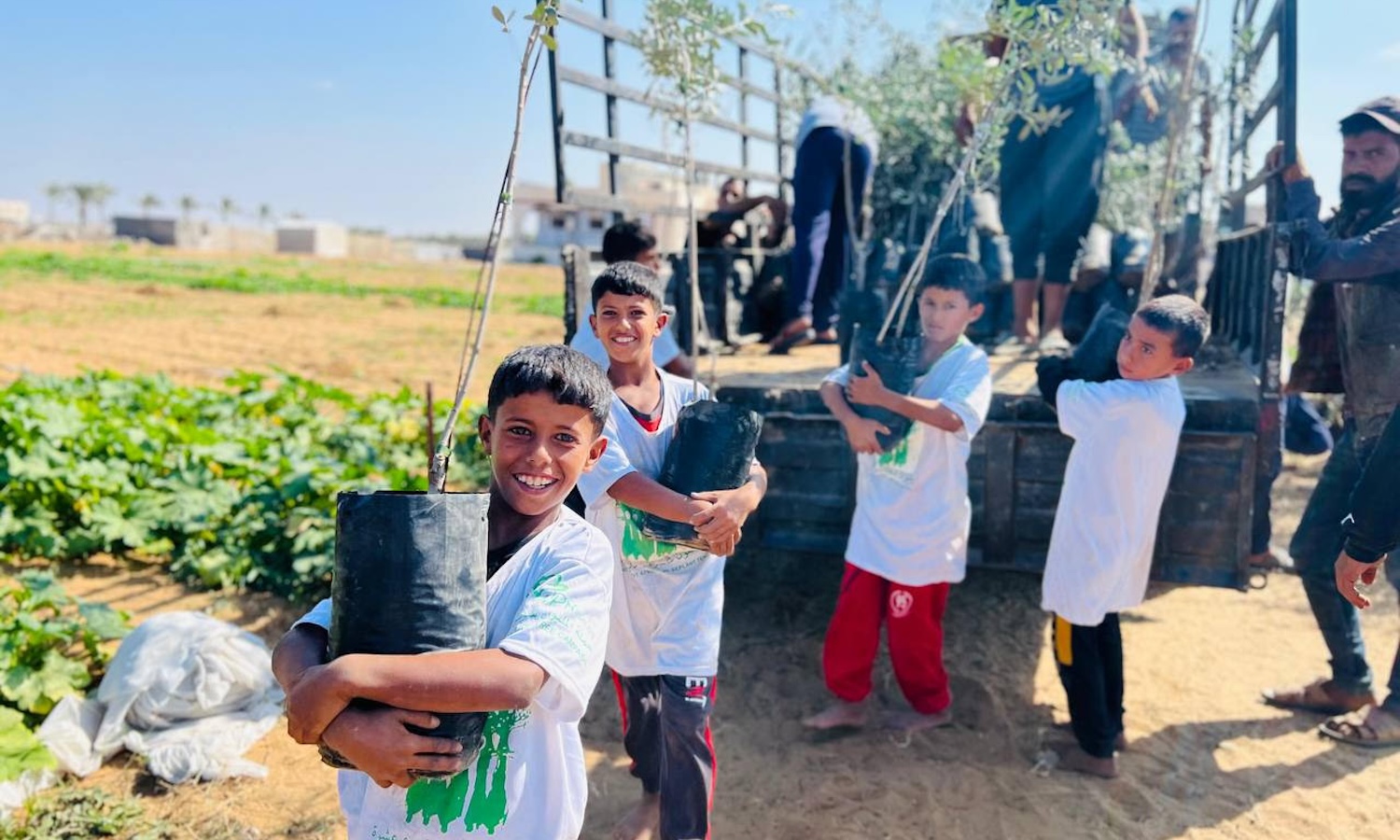
The Revive Gaza’s Farmland Project launched by the Arab Group for the Protection of Nature (APN), is a coalition of farmers working to restore and cultivate farmland across Gaza. They hope to bolster food security and food sovereignty for Palestinian people.
Less than five percent of the Gaza Strip’s total land remains available for cultivation, after cropland areas have been damaged or made inaccessible to farmers, according to the Food and Agriculture Organization (FAO). But rather than focus on the destruction, Razan Zuayter, Founder and Chairperson of the APN, tells Food Tank that the Project aims to “highlight what endures.”
Since March 2024, the Project has supported the cultivation of 1,341 dunums (~331 acres) of land, producing over 7 million kilograms of vegetables including eggplants, zucchini, cucumber, tomato, melon, and molokhia. The grassroots connection between farmers and families allows vegetables to directly reach over 12,000 people under siege, the Project reports.
This comes at a time when the World Health Organization (WHO) and the United Nations report that Gaza has faced systematic starvation. According to the latest U.N. analysis, the recent ceasefire helped to offset famine conditions, but food security in Gaza is still under threat. More than three-quarters of the population face acute hunger and malnutrition.
“Gaza’s children are no longer facing deadly famine, but they remain in grave danger,” says Lucia Elmi, UNICEF Director of Emergency Operations.
Zuayter says the Revive Gaza’s Farmland Project is working to address the dire situation. But under the Defense Export Control Law, Israel regulates the entrance of all goods into the Gaza Strip and restricts items it dubs as having potential for both civilian and military use. Since 2023, these restrictions prohibit the entry of food sources like tomato seeds, date pits, or coriander seeds.
“By reviving Gaza’s agricultural capacities through internal procurement and local production, we strengthen a food system resistant to blockade and man-made famine,” Zuayter tells Food Tank. “We are breaking the siege from within.”
The Project has distributed over 2.29 million seedlings and approximately 2,939 kg of seeds, in addition to produce baskets, fishing nets, and poultry units. Zuayter adds that they are also working to cultivate an additional 90 dunnums (~22 acres) of land with potatoes, cucumbers, eggplants, and other crops, as well as 30,000 fruit-bearing trees. They are also in the process of restoring three water wells, 17 greenhouses, and 52 beehives.
Cultivating a diversity of crops is essential to upkeeping the legacy of Palestine’s diverse agricultural ecosystem, which Zuayter explains has been targeted by a “colonial ecocide.” Key historic resources like olive groves and below-ground water sources have been destroyed or occupied, and Palestinians have been legally prohibited from harvesting certain traditional plants and crops called “state property” by the Israeli Government. The Palestinian Ministry of Agriculture reports that more than 2.5 million trees have been uprooted by Israeli forces since 1967. This includes 1 million olive trees, which the U.N. notes are a primary source of food and income for many Palestinians.
The restrictions on procuring and harvesting traditional crops “deliberately casts Palestinian traditions of knowledge and stewardship of the land as ecologically harmful,” Zuayter tells Food Tank. The U.N. Trade and Development Conference reports that domestic producers are undermined by Israeli and Western imports that flood Palestinian markets, eliminating the diversity of Palestine’s agricultural system. “Crop diversity is foundational to Palestine’s agricultural and political sovereignty,” Zuayter says.
Zuayter sees agriculture as an act not of resilience, but resistance. “We reject a colonial ‘resilience’ that is framed in terms of passive shock absorption,” she tells Food Tank. Instead, they channel sumud muqawama, a term that refers to “a steadfast resistance that acts to dismantle the structures that produce vulnerability.” She explains this ideology through the motto of the APN’s Million Tree Campaign, which aims to replant olive trees and other fruit-bearing trees on Palestinian land: “They uproot one…we plant ten.”
To date, the APN has planted over 3 million trees and restored critical infrastructure to help farmers to remain rooted on their land.
Based on the FAO’s identification of remaining land available for cultivation and the Project’s yield so far, the APN estimates that they can produce over 12 million kilograms of food grown “for and by the Palestinians of Gaza.” It is, she says, a “a living testament of Palestinian rootedness and agricultural wisdom that long predates empire.”
Articles like the one you just read are made possible through the generosity of Food Tank members. Can we please count on you to be part of our growing movement? Become a member today by clicking here.
Photo courtesy of Arab Group for the Protection of Nature