This summer, find time to explore new practices, solutions, and more with Food Tank’s 2026 summer reading list.
1. Abiding Hunger: An American Paradox by Roger Thurow (Forthcoming September 2026)
For nearly 20 years, Roger Thurow’s books on hunger have taken readers around the globe. His fifth lands in the United States—both one of the world’s biggest food producers and the home of nearly 50 million people experiencing food insecurity. In Abiding Hunger, the former Wall Street Journal foreign correspondent and global agriculture senior fellow at The Chicago Council on Global Affairs traces a history of “hidden hunger” and the systems that continue to fuel it.
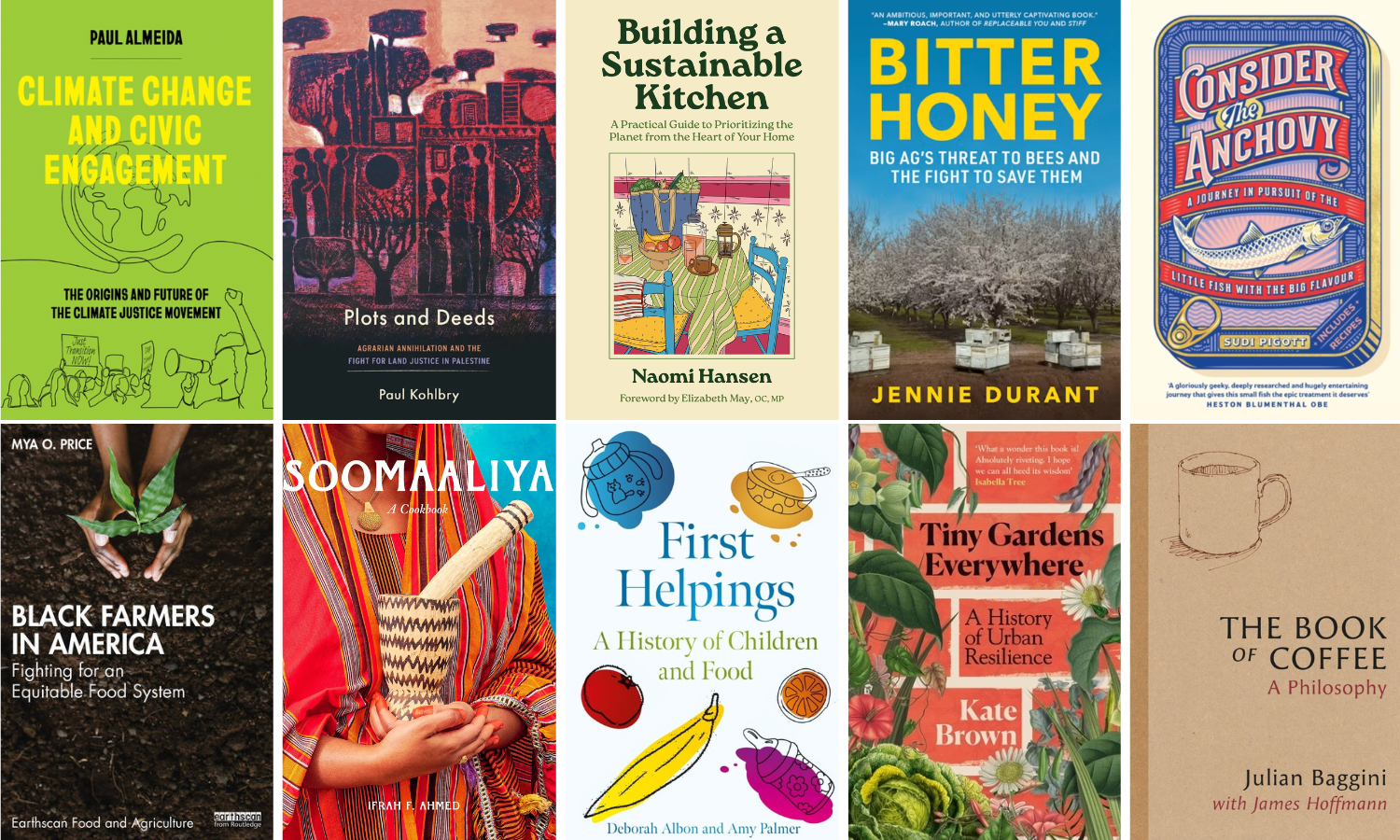
2. Bitter Honey: Big Ag’s Threat to Bees and the Fight to Save Them by Jennie Durant
The title of this book has two meanings for Jennie Durant. On one hand, it references the bitter honey produced by bees when they pollinate almonds—a massive industry that drives nearly all of the nation’s commercial bees to California every year. It’s also a nod to the challenges faced by beekeepers in the United States. Durant, a researcher and former U.S. Department of Agriculture fellow, highlights the communities at the forefront of America’s bee crisis and ultimately vouches for a food system that “works with nature, not against it.”
3. Black Farmers in America: Fighting for an Equitable Food System by Mya O. Price (Forthcoming August 2026)
Mya O. Price is no stranger to the work of food justice, community building, and health advocacy. In Black Farmers in America, Price—a professor at George Washington University’s Global Food Institute—unravels America’s Black agricultural history, present, and future through case studies centering both the resiliency of Black farmers and the benefits of local food systems. Focal points include cooperative farming models in the South, urban agriculture in Detroit, and land reparations in the Mississippi Delta.
4. Building a Sustainable Kitchen: A Practical Guide to Prioritizing the Planet from the Heart of Your Home by Naomi Hansen
For Saskatchewan-based food writer Naomi Hansen, the kitchen is a place where even small habits become gateways to the larger ecosystems that govern our food, environment, and daily lives. Each chapter of Hansen’s Building a Sustainable Kitchen is a crash course in different everyday interactions with food: buying, preparing, eating, disposing, and beyond. Hansen draws connections between how those behaviors matter deeply to a range of environmental issues. She offers tangible strategies on how to improve them, like repurposing leftovers and growing food at home.
5. Cheese Trekking: How Microbes, Landscapes, Livestock, and Human Cultures Shape Terroir by Trevor Warmedahl
After a decade of cheesemaking in the United States, Trevor Warmedahl found himself managing a cheese plant in Mongolia—kickstarting his fascination with and documentation of pastoral cheese production around the world. Cheese Trekking follows Warmedahl across the Eurasian continent, where he discovers everything from yak milk-based aaruul in western Mongolia to goat cheese in the Italian Alps. Combining intimate reflection with technical know-how, the book is an ode to non-industrial cheesemaking traditions and the many living things that partake in them.
6. Climate Change and Civic Engagement: The Origins and Future of the Climate Justice Movement by Paul Almeida (Forthcoming July 2026)
Social movements expert Paul Almeida examines how communities fight for decarbonization and just climate transitions in this data-forward book. It tells success stories of civic engagement and subsequent policy implementations, taking particular interest in the San Joaquin Valley, California’s agricultural hub. Almeida discusses community members’ willingness to pursue climate action as a testament to how deepened public participation can build sustainability practices for generations. He makes a compelling case for the paramount role of collective action.
7. Consider the Anchovy: A Journey in Pursuit of the Little Fish with the Big Flavour by Sudi Pigott
Ask Sudi Pigott about anchovies, and she’ll give many reasons why these “eco saviors” are not only “worthy of appreciation, but of respect and protection.” The food journalist unpacks the small fish’s outsized role in both marine ecosystems and food cultures across the globe, taking readers through anchovy explorations in Athens, Basque Country, the French Riviera, and more. Restaurant owners, fishers, and sobadoras—women who filet anchovies in Cantabria, Spain—are among those who share their expertise in Consider the Anchovy, where each chapter ends with a recipe from its region of focus.
8. Cooking the Borderlands: Spice and Smoke Between Mexico and the States by Claudette Zepeda
Claudette Zepeda was “raised with one foot in each country,” she writes in Cooking the Borderlands. In her first cookbook, the San Diego chef and former Top Chef competitor showcases the diverse foodways of cities in a region often used as a “pawn in a political game.” The chapters move through Zepeda’s memories along the U.S.-Mexico border, from Mexicali—once the home of 19th-century Chinese immigrants working on railroads—and its Chinese food infused with Mexican flavors to Coahuila and Tamaulipas, where Tex-Mex was born and red meat is king.
9. Eating on a Mountain at the End of the World: How I Found Love, Humor, and Beauty in My Quest for Ethical Food by Zackary Vernon
Zackary Vernon’s journey to find balance in his food world—to find ways to “fail better,” as he says—is both deeply relatable and uniquely illustrative in its depiction of alternative foodways. The memoir documents Vernon’s attempts to ethically source, cook, and eat in a tiny Appalachian town, where he grapples with questions that define American food culture and the food choices of many. How much of a difference does buying from local farmers make? What does it mean to eat ethically, and is it feasible to achieve?
10. Eat to Hustle: 75 High-Protein Plant-Based Recipes by Robin Arzón
Robin Arzón didn’t come from a plant-based household. The head instructor at Peloton describes a dinner table filled with Cuban, Puerto Rican, and Jewish staples—and while she maintains a plant-based diet today, the goal has always been to keep flavor and fuel a priority. With advice from registered dietitian Dalina Soto, Eat to Hustle is Arzón’s take on exciting, on-the-go, meatless eating. She includes a macronutrient breakdown in each of her recipes, which incorporate a range of legumes, veggies, and protein supplements into everyday meals. (She is also one of Food Tank President Danielle Nierenberg’s favorite instructors #Robin’sWolfPack).
11. Fermenting for the Future: Japanese Pickles and Microbial Foodways by Aya Hirata Kimura
Consumers might recognize tsukemono as the pickled vegetables in a bento box. Aya Hirata Kimura, however, knows that it’s much more—a small but mighty dish with over a thousand years of history encompassing intersections of health, art, industrialization, and biodiversity in many forms. As fermented foods maintain their popularity in modern wellness culture, Kimura—a multidisciplinary researcher and professor who grew up in Japan and Singapore—traces connections between the environmental, political, cultural, and anatomical elements of the food system, all via a deep dive into this everyday Japanese staple.
12. First Helpings: A History of Children and Food by Deborah Albon and Amy Palmer (Forthcoming July 2026)
First Helpings explores the history of children’s foodways and the people, corporations, places, and systems that influence their diets and perceptions of food itself. Beyond the question of what kids should eat, the book examines the politics of school meals, social cues at the dinner table, and the historical struggle of child hunger. Focusing on children in Britain, childhood studies professors and former teachers Deborah Albon and Amy Palmer point to food as a crucial gateway to understanding children’s history and bettering their futures.
13. Food Policy Councils: Building Civic Engagement and Community Well-Being by Nessa J. Richman (Forthcoming July 2026)
The United States is home to more than 300 food policy councils—although few Americans know that they exist or what they do. Nessa J. Richman—the executive director of the Rhode Island Food Policy Council—offers a look at the regional and local groups of food-focused citizens working for increased food access, sovereignty, and more in their communities. The book gives advice for existing councils on bolstering civic participation, fundraising, and working with elected officials, as well as a roadmap for food systems advocates to build new councils from the ground up.
14. Ice Cream Queen: Flavors from Black America’s Past, Present, & Future by Lokelani Alabanza
Sarah Estell, a Black woman who owned an ice cream shop in the 1840s, was known as the “Ice Cream Queen.” In Ice Cream Queen, Lokelani Alabanza honors the Black pioneers who “deserve front-and-center placement in the canon of American ice cream.” The Nashville-based pastry chef highlights Southern Black foodways with recipes like Pepper Jelly & Cream Cheese and Juneteenth Sorbet swirled with raspberry-hibiscus syrup. The cookbook is also ripe with historical knowledge, featuring a timeline of Black ice cream makers and brief lessons on the cultivation of ice cream’s key ingredients.
15. It’s on You: How Corporations and Behavioral Scientists Have Convinced Us That We’re to Blame for Society’s Deepest Problems by Nick Chater and George Loewenstein
Consumer responsibility isn’t everything, and big changes require new rules, behavioral scientists Nick Chater and George Loewenstein argue. The food system comes into play several times in It’s on You, which unpacks how the United States tried to fight its obesity epidemic by “blaming the victim” and how eaters are expected to reduce their carbon footprints to mitigate the climate crisis. The book provides a unique take on personal responsibility, criticizing “nudge” policies for preventing communities from making real progress.
16. Our Knives Will Save Us: Dispatches from a White Mountain Apache Chef by Nephi Craig (Forthcoming July 2026)
The healing power of cooking is the heart of Our Knives Will Save Us. Nephi Craig—who grew up on the White Mountain Apache reservation in Arizona—recounts the journey of personal hardship, culinary and cultural rediscovery, and revitalization that took him across the globe before landing back in his hometown of Whiteriver. The memoir expounds Craig’s studies of Indigenous foodways, which catalyzed both the formation of his identity as a chef and his 2021 opening of Café Gozhóó in Whiteriver, an Indigenous restaurant that employs individuals recovering from substance abuse.
17. Plots and Deeds: Agrarian Annihilation and the Fight for Land Justice in Palestine by Paul Kohlbry
Paul Kohlbry brings readers to three Palestinian villages, where he met peasants operating a food cooperative, sowing seeds, and protesting land theft. The anthropologist and professor challenges assumptions of peasants as either “heroic revolutionaries or tragic victims” and unravels how Israeli occupation, inflation, and real estate developers’ commodification of land merge to create “agrarian annihilation.” In doing so, Kohlbry amplifies the voices of farmers fighting for “both the return of the land that was taken, and a return to the land.”
18. Soomaaliya: Food, Memory, and Migration: A Cookbook by Ifrah F. Ahmed
“Because of Somalis’ historic reliance on a rich oral tradition,” Ifrah F. Ahmed writes, you won’t find many Somali cookbooks. Restaurants too are relatively few abroad, where Somali food is often misattributed or lumped under the umbrella of a large region, according to Ahmed. Soomaaliya—named for the country Ahmed and her family left in 1996 as refugees—is the writer and chef’s way of spotlighting her homeland and its diaspora. Its recipes, including green hot sauces and teatime beignets known as bur, are accompanied by vivid profiles of Somalian restaurateurs, food producers, and more.
19. Spain My Way: Eat, Drink, and Cook Like a Spaniard by José Andrés and Sam Chapple-Sokol
José Andrés has always kept his roots in Spain, where he was raised and learned to cook and which he now celebrates with Spain My Way. The restaurateur and humanitarian—with Sam Chapple-Sokol, editorial director of his restaurant group—presents 130 recipes encapsulating what he likes to cook at home, including both Spanish staples and unique local specialties. The cookbook is a love letter to commensality, and full of lessons in what Andrés calls the two distinguishing traits of Spanish food: “amazing products and a deep respect for time.”
20. The Book of Coffee: A Philosophy by Julian Baggini
The Book of Coffee positions its subject as something that is ubiquitous, mundane, and sometimes, an afterthought. Mundane in this case, however, doesn’t mean boring, but wonderfully simple in how easily coffee exemplifies much more than a hit of caffeine. With beginning and ending words from barista and content creator James Hoffman, food philosopher Julian Baggini navigates the beverage’s social meanings with curiosity and joy. He uncovers how modern coffee culture has come to not only inspire aesthetic appreciation but represent a desire for “a life that is at ease with itself.”
21. The Farm Is Here by Jeff Tkach
Combining memoir, agriculture research, and deep reflections on what it means to nourish the soul, The Farm Is Here is a look into the minds of one of regenerative agriculture’s biggest cheerleaders. Jeff Tkach, the CEO of the Rodale Institute, recounts how his own battle with a disease led him to discover intimate relationships between soil health and human health. The book urges readers to find meaning in connecting deeply and sustainably with their food—especially on the farm, which Tkach believes can “transform nearly every area of our lives.”
22. Tin Can Coast: A History of Industry, Greed, and Fishing in the Golden State by Joseph Ogilvy (Forthcoming July 2026)
As tinned fish packed in fancy olive oil remains all the rage on store shelves, Joseph Ogilvy takes the conversation to California, whose complicated fishing history remains overlooked. Tin Can Coast reckons with the state’s often exploitative relationship with its coasts. The chef and writer explores how the California Current—once home to troves of large yellowfin tuna, abalone, and sardines—became a gold mine for profit. Ogilvy traces the geopolitical, capitalist, and cultural forces that led to the growing popularity of seafood, racist immigrant policies, and the depletion of sea once brimming with life.
23. Tiny Gardens Everywhere: A History of Urban Resilience by Kate Brown
Urban sprawl and a lack of green space dominate the ecological narrative of today’s cities, but Tiny Gardens Everywhere rejects that notion. Environmental historian Kate Brown unpacks how small gardens run by the working class across Europe and North America gave roots to community building, surprising biodiversity, and nutritious food production in unexpected places. The book gives long-overdue credit to the 19th- and 20th-century urban gardeners who achieved “many of the goals of contemporary food sustainability reformers.”
Articles like the one you just read are made possible through the generosity of Food Tank members. Can we please count on you to be part of our growing movement? Become a member today by clicking here.