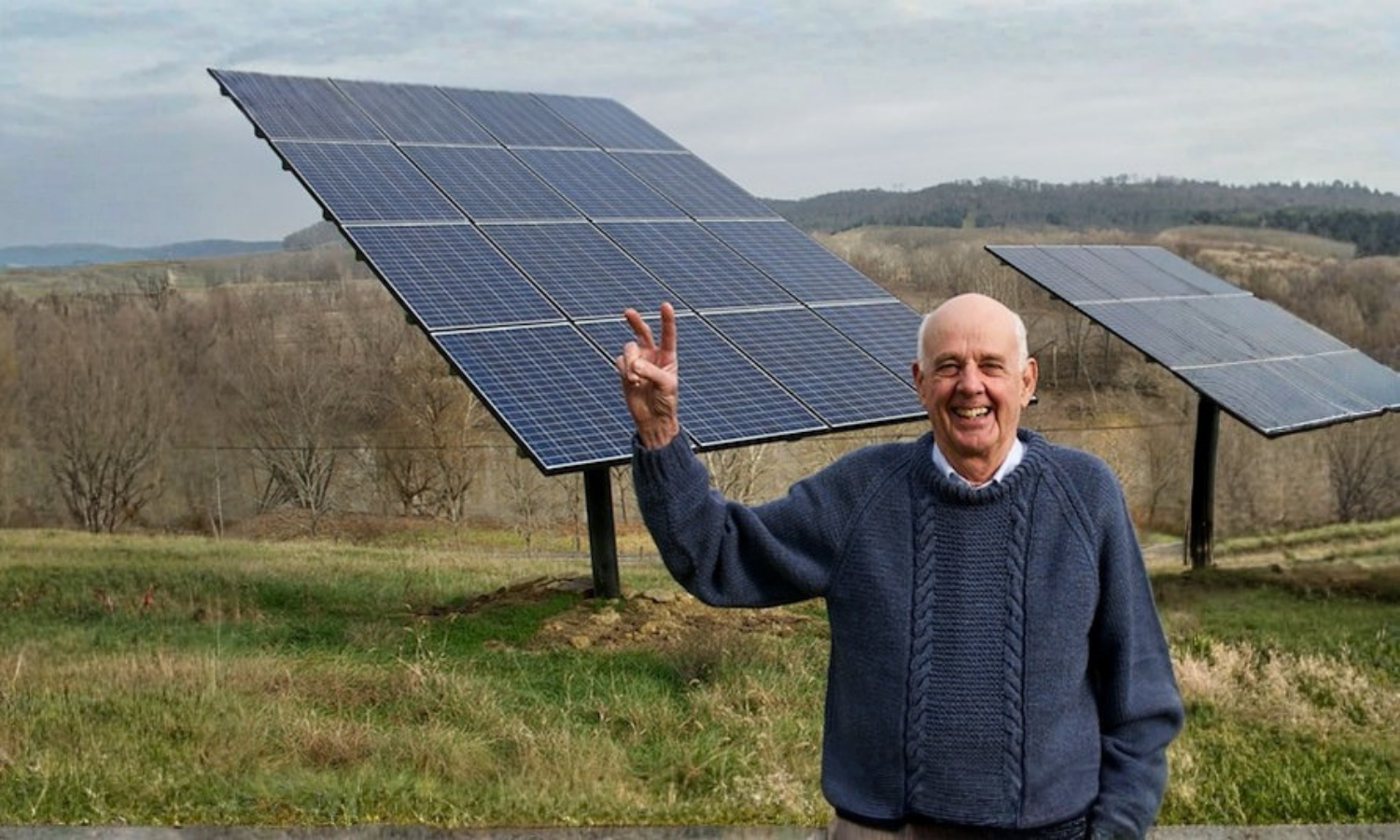
Wendell Berry, a farmer, writer, and advocate whose work challenged industrial agriculture and defended the ties between land, food, and community, died at his home in Port Royal, Kentucky, according to the New York Times (NYT). He was 92.
A poet, novelist, essayist, teacher, conservationist, activist, and farmer, Berry resisted easy categorization. “Berry has refused to specialize,” Charles Hudson wrote in the Georgia Review.
Throughout his five-decade career, Berry argued that agriculture was inseparable from the health of the land and the communities that depend on it. He questioned the consolidation and industrialization of farming while championing small farms, local economies, and responsible stewardship.
Born in Louisville, Kentucky, in 1934, Berry grew up in Henry County, where his family had farmed for generations. He earned bachelor’s and master’s degrees in English from the University of Kentucky before joining Stanford University’s creative writing program as a Wallace Stegner Fellow.
He later traveled to Europe and taught in New York, but felt increasingly drawn back to his roots. Berry returned to Port Royal in the 1960s. He and his wife, Tanya, settled on a 125-acre farm, where they raised sheep and crops. He spent the rest of his life there writing and farming.
Living in his native landscape kept him accountable to the place and people he described, Berry told the NYT in a phone interview in 2018 for his obituary.
From his home, Berry analyzed the consequences of an agricultural system increasingly defined by consolidation, mechanization, chemicals, and soil degradation. He examined the disappearance of small farms and rural communities, and how their absence threatened individual liberty, local autonomy, and economic independence.
Those concerns became the foundation of his body of writing. Berry published more than 50 books of poetry, fiction, and essays, all written by hand during daylight hours. His farmhouse had electricity, but he refused to use electric lights because, he said, the power was supplied by strip-mined coal.
His 1977 book The Unsettling of America: Culture & Agriculture argues that agriculture is the foundation of America’s culture. The book questioned U.S. policies promoting practices that he argued lead to overproduction, pollution, and soil erosion.
Berry examined these ideas further in The Gift of Good Land and Home Economics, collections that examining organic farming. He argued that the values driving industrial agriculture were eroding family farms and weakening what he regarded as a foundation of American society.
In a New Perspectives Quarterly interview Berry commented that large-scale agriculture is morally as well as environmentally unacceptable: “We must support what supports local life, which means community, family, household life—the moral capital our larger institutions have to come to rest upon. If the larger institutions undermine the local life, they destroy that moral capital just exactly as the industrial economy has destroyed the natural capital of localities—soil fertility and so on. Essential wisdom accumulates in the community much as fertility builds in the soil.”
The issues that animated Berry’s essays also shaped his fiction. Through novels and short stories set largely in the fictional Kentucky town of Port William, he chronicled generations of farmers, families, and neighbors confronting the economic and technological changes reshaping rural life.
Berry also carried his convictions beyond the page. He joined protests against the Vietnam War, nuclear power, mountaintop-removal coal mining, coal-fired power plants, and the death penalty.
In 1979, Berry was arrested for trespassing while protesting the Marble Hill Nuclear Power Plant in Madison, Indiana. Recalling the episode in 2010, he said, “People asked if I wanted to be arrested and I said, ‘Hell No’ but I was willing to be.”
The National Endowment for the Humanities described him in 2012 as “cheerful in dissent” and a person who “writes to document and defend what is being lost to the forces of modernization.”
His writing and advocacy earned more than 30 honors. President Barack Obama awarded Berry the National Humanities Medal for his achievements as a poet, novelist, farmer, and conservationist, and the National Book Critics Circle honored him with its Ivan Sandrof Lifetime Achievement Award in 2016.
He also earned honors including the T.S. Eliot Prize, the Aiken Taylor Award, the John Hay Award and the Richard C. Holbrooke Distinguished Achievement Award of the Dayton Literary Peace Prize, according to the Poetry Foundation.
His ideas continue through The Berry Center, established in 2011 to put Berry’s “writings to work” by supporting farmers, land-conserving communities, and healthy regional economies.
Food Tank Co-founder and President Danielle Nierenberg had the privilege of both meeting and hearing Berry speak over the last two decades. She says that he inspired so many of us as food and agriculture system advocates not only with his poems and books, but his love of the land and farmers.
In addition to his wife and daughter, Berry is survived by his son, Pryor, who goes by Den, two sisters, Mary Jo Berry and Martha Baxter, five grandchildren, and four great-grandchildren.
“There’s not enough I could say about him to do him justice,” his daughter, Mary Berry, told the Associated Press.
Articles like the one you just read are made possible through the generosity of Food Tank members. Can we please count on you to be part of our growing movement? Become a member today by clicking here.
Photo courtesy of Wikimedia