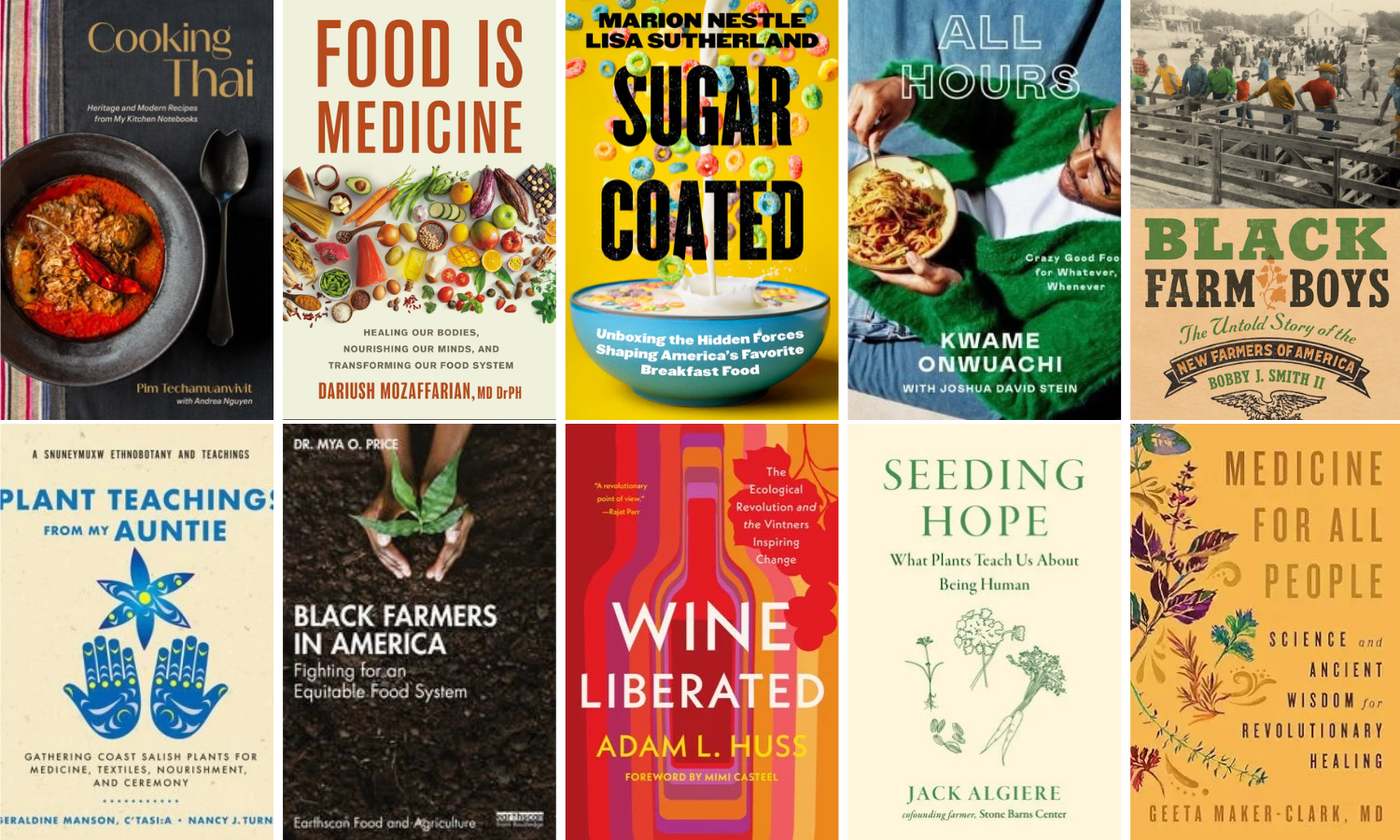
This Fall, Food Tank is highlighting 24 books that help us understand how food connects us to our communities, cultural heritage, and the natural world. Food is Medicine by Dariush Mozaffarian and Food Sense by Christopher Gardner both tackle pressing questions that will help us create systems that support mental and physical wellbeing. In Sugar Coated, Marion Nestle and Lisa Sutherland examine American breakfast cereals to expose the strategies big food companies have used to influence food policy and public health. And in Cooking Thai, award-winning chef Pim Techamuanvivit broadens readers’ understanding of Thai cuisine with 100 of her best recipes. Together, these titles offer inspiration and insights for creating a sustainable, more equitable food future.
1. A Practical Farmer’s Journey: A History of Community, Stewardship, and Resilience by Ronald L. Rosmann
More than 60 percent of Iowa farmland is dedicated to corn and soybean, according to research from Iowa State University. But the state is also home to another story—one of transformation. Ronald L. Rosmann traces the history of agriculture in Iowa, from when farming offered families promise and hope to the struggles driven by vertical integration. The book closes with a message of optimism, highlighting how Iowa’s farmers are rebuilding rural communities, tackling climate change, and restoring the unfulfilled potential of rural America.
2. All Hours: Crazy Good Food for Whatever, Whenever by Kwame Onwuachi with Joshua David Stein
The San Francisco Chronicle calls James Beard Award-winning Kwame Onwuachi “the most important chef in America.” In his new cookbook, he shares recipes that bring together unexpected flavors in dishes that can be enjoyed for any occasion and any time of day. It covers everything from breakfast to late night snacks, with dishes such as Corn Milk French Toast, Curried Chicken Patties, Brussels Sprout Suya, and Sticky Toffee Pudding.
3. Black Farm Boys: The Untold Story of the New Farmers of America by Bobby J. Smith II
Black Farm Boys unearths the history of New Farmers of America, the first—and overlooked—national organization for Black boys studying agriculture in segregated high schools. Sociologist Bobby J. Smith II details the growth of the NFA, its influence, and its swift decline as it was overtaken by the predominantly white Future Farmers of America. The book confronts the question of how an organization with 55,000 members at its peak was nearly forgotten from history in the United States.
4. Black Farmers in America: Fighting for an Equitable Food System by Mya O. Price
Mya O. Price’s research highlights how systems of oppression have shaped the experiences of Black farmers in the United States from slavery to the present day. It also uncovers the ways they are overcoming these barriers. Black Farmers in America brings these pieces together, grounding readers in history. And it offers case studies that show how models of restorative justice, cooperative farming, and urban agriculture are creating opportunities for Black food producers to build power and resilience.
5. Captive Consumers: Hunger, Violence, and Inequality in American Prison Food by Chin Jou
Captive Consumers questions assumptions about what a food system inside prisons can—and should—look like. Drawing from historical records and prison newspapers, author Chin Jou documents the challenges incarcerated people face, from chronic hunger to unmet dietary needs. She argues that these conditions perpetuate violence and endanger those inside these institutions, ultimately making the case for reform that centers dignity and humanity.
6. Cooking Thai: Heritage and Modern Recipes from My Kitchen Notebooks by Pim Techamuanvivit with Andrea Nguyen
When Pim Techamuanvivit moved to the United States from Bangkok, she encountered assumptions around Thai food she was eager to change. In response, the award-winning chef opened multiple restaurants to celebrate the richness and diversity of her culinary heritage. In Cooking Thai, Techamuanvivit brings together 100 of her best recipes like Massaman Curry with Beef Cheeks and a Grilled Shrimp and Lychee Salad, while providing tips to help cooks source ingredients at home.
7. Depression Cooking: Feeding Yourself When It All Feels Too Hard by Sonali Menezes
It can be challenging to feed yourself during difficult times. That’s what artist Sonali Menezes realized when she was struggling with mental illness and disordered eating. It drove her to look for easy, delicious ways to stay nourished, leaning into approaches that were non-judgmental, anti-diet, and approachable. In Depression Cooking, Menezes combines recipes, memoir, and illustrations to share lessons from these hard times. It serves as a guide to caring for yourself when you’re navigating grief, unemployment, or the stress of becoming a new parent.
8. Famine in World History by R. Douglas Hurt
Douglas Hurt offers an overview of famines throughout history, from antiquity to the present day. While acknowledging that not all cases are alike, he points to patterns that emerge in examples from western Europe, China, Southeast Asia, and Africa. Hurt also delves into the roles that policy and war play, how environmental issues intersect with hunger crises, and what happens to communities after famines end.
9. Food Heritage: Critical Perspectives edited by Loïc Bienassis and Fabio Parasecoli
“Does food heritage exist?” That’s the question historian Loïc Bienassis opens with in his introduction to this new anthology. The chapters that follow aim to understand what food heritage means and the ways that foods and food practices are defined, recognized, and mobilized as heritage. To unpack these questions, chapters span the globe, drawing on case studies from countries including Brazil, Catalonia, Japan, and Morocco.
10. Food Is Medicine: Healing Our Bodies, Nourishing Our Minds, and Transforming Our Food System by Dariush Mozaffarian (forthcoming October 20)
“Being a healthy American adult is an anomaly,” cardiologist Dariush Mozaffarian tells Food Tank. He believes food systems represent the biggest challenges facing humanity today. As Director of the Food is Medicine Institute, Mozaffarian says, “we really can actually fix our food system in a really short amount of time.” In Food Is Medicine, he explains the decisions that have shaped food systems today and offers a blueprint to help policymakers, physicians, communities, and individual eaters drive a nutrition revolution.
11. Food Sense: What to Eat and Why by Christopher Gardner
In Food Sense, nutrition scientist Christopher Gardner tackles myths about diet and health on to eaters make more informed choices about the food they put on their plates. He acknowledges that health claims can be confusing and contradictory, and he hopes to use his book to cut through the noise. His book addresses questions on everything from seed oils to plant-based proteins while pointing readers to some of his favorite recipes that support long-term health.
12. Fundamentals of Flavor: 100 Recipes for the Science of Better Cooking by Nik Sharma
Former molecular biologist Nik Sharma wanted to help eaters make delicious meals at home while understanding the science behind their food. The result is Fundamentals of Flavor, a cookbook containing 100 recipes, from Caramelized Shallot and Feta-Labneh Dip to Icelandic Rye Bread, that are accessible yet rich in flavor. It’s also filled with information on how different cooking techniques bring out the most in every dish.
13. Foods of La Frontera: Recipes and New Taste Frontiers from Both Sides of the Border by Pati Jinich
In Foods of La Frontera, Pati Jinich offers 125 recipes to celebrate the region where the United States and Mexico meet. Rather than calling it the border, Jinich thinks about it as a frontier—a place of beginnings, opportunity, and rich, varied cultures. Dishes such as Tamales de Frijol con Chile Verde y Queso (Mashed Bean, Green Chile, and Cheese Tamales) and Enchiladas Navideñas de Pollo (Christmas Chicken and Cheese Enchiladas) demonstrate that the cuisine is more than traditional Tex-Mex, encompassing cooking styles and ingredients from across Mexico.
14. Happy Snacking, Don’t Die! Foraging and Vegan Recipes with Black Forager by Alexis Nikole Nelson
Alexis Nikole Nelson, also known as BlackForager on social media, uses her platform to educate others on foraging and cooking wild foods. In Happy Snacking, Don’t Die!—part foraging guide and part plant-based cookbook—Nelson shares her love for the outdoors and encourages people to safely embrace the abundance that surrounds them. Recipes include Magnolia Bud Tea, Stuffed Morels, and Potato Mugwort Pancakes.
15. How to Cook Everything Vegan: Build on the Basics for Exciting Plant-Based Meals by Mark Bittman
In the latest installment of the How to Cook Everything series, Mark Bittman makes plant-based cooking accessible and craveable. This collection of straightforward recipes covers everything from paellas and dumplings to ice cream and cookies. Bittman also includes technique and ingredient guides to help home cooks feel more comfortable and empowered in the kitchen.
16. Medicine for All People: Science and Ancient Wisdom for Revolutionary Healing by Geeta Maker-Clark
Integrative medicine physician Geeta Maker-Clark learned at an early age that food is medicine. But many people, she knows, didn’t have the experience. Even many doctors go without adequate nutrition training. “Food got pushed out of medical education,” Maker-Clark tells Food Tank. Medicine for All People encourages readers to embrace the healing properties of food, along with other medicines of the Earth, community, and the spirit that are ancient and urgently relevant. It also helps readers build their own kitchen apothecary, use breathwork to calm the mind, and integrate dance meditation into daily life.
17. Plant Teachings from My Auntie: Gathering Coast Salish Plants for Medicine, Textiles, Nourishment, and Ceremony by C’tasi:a, Geraldine Manson and Nancy Turner
Plant Teachings from My Auntie introduces readers to herbal remedies found in the traditional territory of the Snuneymuxw First Nation. Geraldine Manson (C’tasi:a), a Snuneymuxw Elder and Traditional Knowledge Keeper, shares lessons from her aunt, Dr. Ellen White, to foster cultural understanding and ecological responsibility. Throughout the book are detailed descriptions of 65 different species and more than 130 beautiful color photographs to support accurate plant identification.
18. Reining in the Bulls: How to Stop Corporate Abuse in an Age of Unbridled Greed by Michael Marx
Corporations hold immense power that too often goes unchecked by government, leading to pollution, dangerous work environments, and defective or harmful products. In Reining in the Bulls, Michael Marx offers advocates practical guidance to challenge corporate abuses. Drawing from his experience pressuring companies to change their ways, he helps advocates understand, plan, and execute effective campaigns that can build more equitable and just systems.
19. Saved by Seeds: Embracing Diversity, Adaptation and Resilience by Chris Smith
In Saved by Seeds, Utopian Seed Project Founder Chris Smith makes the case for seed diversity. He explains how seed saving can build resilience, unpacks the beliefs holding us back, and offers guidance for farmers and gardeners of all backgrounds to play an active role in building adaptive, dynamic food systems. The book shows that seed saving isn’t just a practice of the past, but one that is still highly relevant and necessary to carry us into the future.
20. Seeding Hope: What Plants Teach Us About Being Human by Jack Algiere
As Director of Agroecology at the Stone Barns Center for Food and Agriculture, Jack Algiere has dedicated his career to scaling farming practices rooted in land stewardship, innovation, and community. In Seeding Hope, Algiere shares the lessons that he has learned along the way, highlighting how deeply connected humans are to the world around them. As Chef Dan Barber of Blue Hill and Blue Hill at Stone Barns says, the book is ultimately “a portrait of the natural world as teacher, and an ethic for how to live, drawn from the ground up.”
21. Sugar Coated: Unboxing the Hidden Forces Shaping America’s Favorite Breakfast Food by Marion Nestle and Lisa Sutherland
Sugar Coated by nutritionist Marion Nestle and former Kellogg executive Lisa Sutherland, reveals the influence American cereal companies have on food policy and public health. The book digs into marketing tactics, from ads targeting children to health claims, that companies have employed to make these sugary foods the breakfast staple they are today. When did it become okay to feed kids vitamin-supplemented cookies for breakfast, “which is basically what kids’ cereals are?” Nestle asks.
22. Sustainable Agriculture in Ukraine: From Resource-Intensive Farming to Agroecological Systems by Sergiusz Pimenow, Olena Pimenowa, and Lubov Moldavan
Sustainable Agriculture in Ukraine helps readers understand how the country can transition to farming systems that are more environmentally sound and resilient—and why this matters for global food security. Economists Sergiusz Pimenow, Olena Pimenowa, and Lubov Moldavan break down the evolution of Ukrainian agriculture and how it fits into global food systems, while considering the trajectory of post-war recovery and offering a roadmap for a more sustainable future.
23. The Ecology of Food: Sustainable Food Systems and Diets edited by Nicolas Bricas, Damien Conaré, and Marie Walser
The Ecology of Food marks the 10th anniversary of the UNESCO Chair in World Food Systems, a platform created to increase and disseminate academic knowledge on world food systems. Broken into five parts, the anthology considers food as relationships, the dynamics of contemporary food systems, food and ecology, guiding principles of sustainable food systems, and the transformation of food systems. Together, these essays offer a well-rounded introduction to contemporary issues in food, farming, and nutrition.
24. Wine Liberated: The Ecological Revolution and the Vintners Inspiring Change by Adam Huss
Just a few grape varieties dominate the wine market today, a fact that prompted winemaker Adam Huss to ask if it’s possible to build something different. Several years ago, he launched the podcast “Beyond Organic Wine” to learn from producers who are rethinking wine. Now, in Wine Liberated, he takes a deeper dive into these questions to understand what it will take to transform the wine industry into one that is environmentally sustainable, diverse, and more delicious.
Articles like the one you just read are made possible through the generosity of Food Tank members. Can we please count on you to be part of our growing movement? Become a member today by clicking here.