

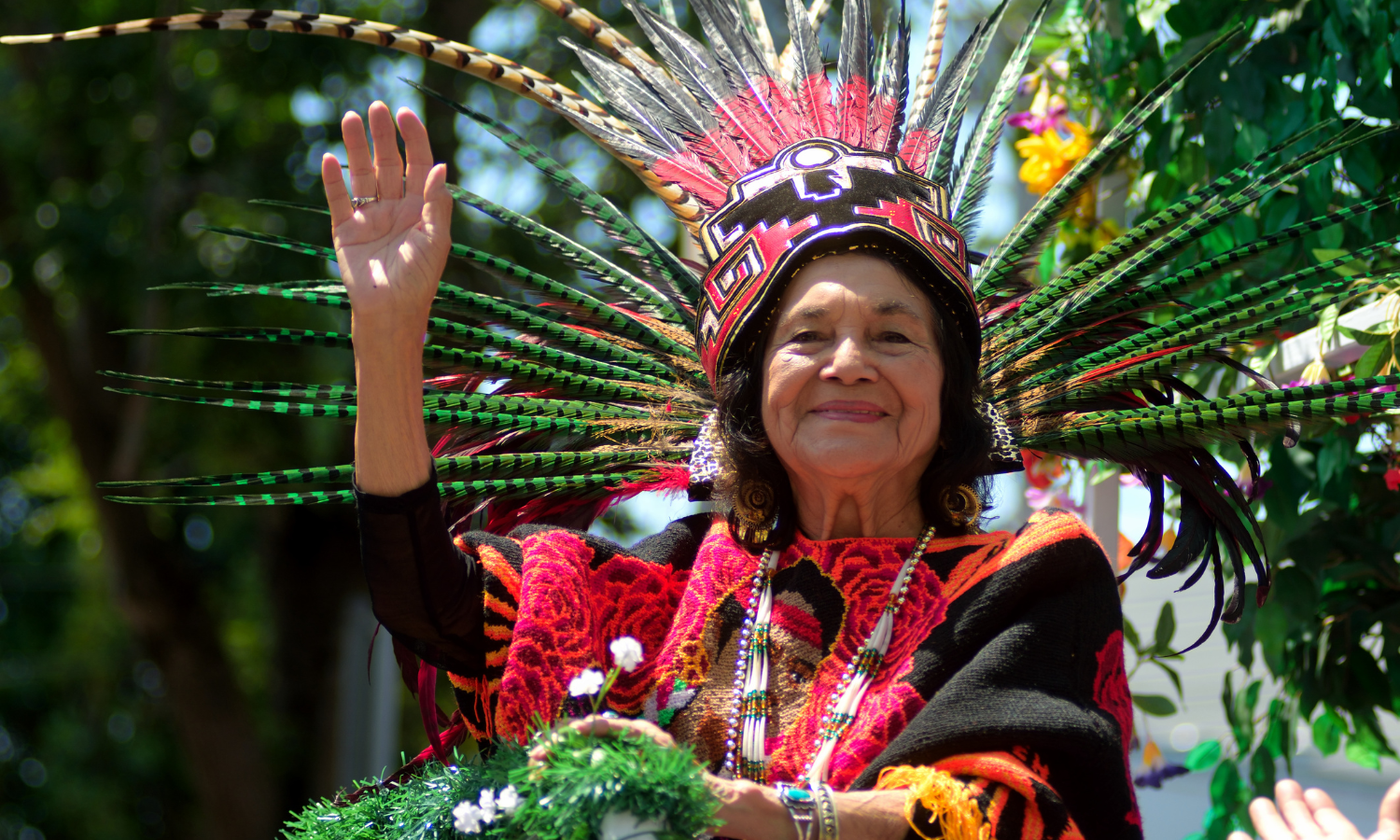
Dolores Huerta, a labor leader and civil rights activist who co-founded the organization that became the United Farm Workers (UFW), died on October 28, 2026, at her home in Bakersfield, California, according to the Dolores Huerta Foundation. She was 96.
“Her life’s work was to empower her community to face and overcome injustices, and she has left farm workers and the entire Latino community stronger and more organized than she found it,” UFW President Teresa Romero said in a statement.
Born Dolores Clara Fernández on April 10, 1930, in Dawson, New Mexico, Huerta grew up in Stockton, California. After earning a teaching credential, Huerta began working as an elementary school teacher in the San Joaquin Valley.
Witnessing the poverty experienced by her students and their families, she decided to pursue community organizing. “I thought I could do more by organizing farmworkers than by trying to teach their hungry children,” she recalled in a 2017 PBS Independent Lens documentary about her life.
Huerta became involved with the Community Service Organization (CSO), a Latino civil rights group. She organized voter registration drives, advocated for improvements in underserved neighborhoods, and founded the Agricultural Workers Association.
She met fellow organizer César Chávez in 1955, and in 1962, Huerta and Chávez established the National Farm Workers Association. The organization later merged with the Filipino-led Agricultural Workers Organizing Committee to form what became the United Farm Workers.
During the Delano grape strike in 1965, Huerta helped organize a nationwide boycott that brought millions of consumers into the campaign and put economic pressure on California grape growers. In 1970, after five years of strikes and boycotts, Huerta helped negotiate collective bargaining agreements which secured higher wages, health benefits, pensions, and protections against unsafe working conditions.
In 1963, she helped secure disability insurance and Aid to Families with Dependent Children benefits for California agricultural workers. She later helped build support for the state’s Agricultural Labor Relations Act of 1975. The law established farmworkers’ right to union representation and required employers to bargain in good faith with unions chosen by their employees.
Beyond wages and labor rights, Huerta fought to protect farmworkers from hazardous pesticides and helped organize a boycott to pressure growers to reduce their use. She also advocated for immigration reform, reproductive rights, and greater political representation for women and Latino communities.
“As a Latina in the labor movement, she challenged the norms that kept women of color out of those spaces and brought women and families onto picket lines and up the ranks of unions and community organizations,” Neidi Dominguez, Executive Director of Organized Power In Numbers, said in a statement. “She showed that women were and are central to the farmworkers and all workers’ collective struggle.”
She coined the phrase “Sí, se puede,” or “Yes, it can be done,” which became a rallying cry for labor and civil rights movements.
Huerta was jailed 22 times during labor demonstrations and endured threats and violence throughout her career. In 1988, while protesting then-Republican presidential candidate George H.W. Bush, Huerta was struck by a police officer’s baton, breaking several ribs and rupturing her spleen. Following her recovery, she continued organizing and increasingly focused on women’s rights and encouraging Latinas to seek elected office.
In March 2026, Huerta bravely disclosed in an interview with the The New York Times that Chávez had sexually assaulted her twice during the 1960s. Both assaults resulted in pregnancies.
Huerta explained in a statement that she had remained silent for decades because she feared revealing the abuse would undermine the farmworker movement. “The farmworker movement has always been bigger and far more important than any one individual,” Huerta wrote.
After stepping down from her leadership role at UFW, Huerta established the Dolores Huerta Foundation in the early 2000s. The organization supports community organizing and civic participation, particularly in California’s San Joaquin Valley. It has trained thousands of community members to advocate for improvements in education, environmental health, public services, and political representation.
Huerta’s contributions earned numerous honors, including the Eleanor Roosevelt Award for Human Rights in 1998 and the Presidential Medal of Freedom in 2012. She was also the first Latina inducted into the National Women’s Hall of Fame. Schools are named in her honor in California, Texas and Colorado. She received 15 honorary degrees.
Food Tank President Danielle Nierenberg had the chance to meet Huerta several years ago in California and remembers that “she was magnetic and so full of energy. Her leadership inspired so many people in the food and agriculture movement.”
Huerta continued participating in demonstrations, registering voters, mentoring young organizers, and advocating for underserved communities into her 90s. Throughout her life, she emphasized the importance of empowering people to organize and advocate for themselves.
“I hope that my legacy will be one of an organizer that organized to fight injustice,” Huerta said in the 2025 documentary Seeds of Change: The Life and Legacy of Dolores Huerta. “We want to give our children an inheritance of justice, right, not jewels or property or money.”
Huerta is survived by 14 children, 24 grandchildren, 23 great-grandchildren, and 7 great-great-grandchildren. Her legacy continues through the United Farm Workers, the Dolores Huerta Foundation, and generations of organizers working to advance labor rights and social justice.
Articles like the one you just read are made possible through the generosity of Food Tank members. Can we please count on you to be part of our growing movement? Become a member today by clicking here.
Photo courtesy of Wikimedia