With private-sector power and resources, major food brands can help spearhead significant food system transformations—but only if they embrace transparency and long-term thinking.
At Food Tank’s annual “Mission Driven Brands Sustainability Summit” at Climate Week NYC, founders and corporate sustainability officers had candid conversations about building trust in the food system.
“We’re making food, so there’s nothing more important than trust,” says Peter McGuinness, CEO of Bel North America. “If we’re making healthy food with real, simple ingredients, we are respecting the planet.”
The event was hosted in partnership with mission-driven brands: Bel US, Northstar Recycling, Global Traceability Framework for Beef and Leather, and Bonterra Organic Estates. You can watch the livestream recording on Food Tank’s YouTube channel.
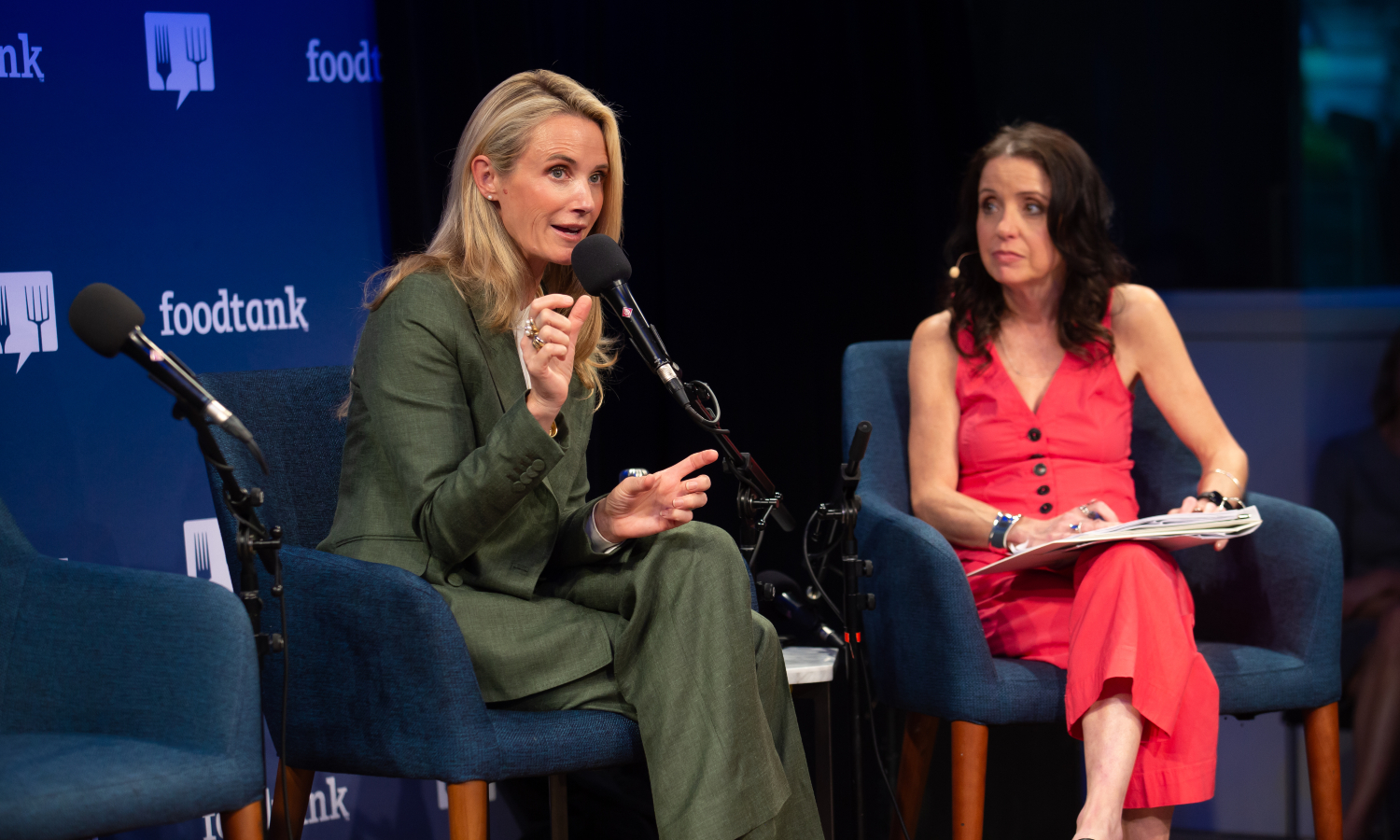
As a surprise guest for a fireside chat, Jennifer Siebel Newsom, First Partner of California, grounded the audience in discussing the beneficiaries of better food-industry practices: The next generation.
“As a mother of four, I was trying to feed my own children local and organic,” she told the packed crowd. “I thought, ‘I can’t just be nourishing my own children, but all California children need to have this.’ … It’s a shame that we’ve been feeding kids such horrible food for so long.”
So how do we steer the ship? Trust is one of the most powerful resources a food business has—and also one that requires constant work to maintain, leaders agreed. This means both trust in individual companies and trust in broader institutions, like the food system at large.
“Consumers more than ever want transparency, but they also want to know that they’re eating real food,” says Ann Marie Hourigan, Head of Quality Standards for Whole Foods Market. “There’s a lot of distrust in what’s been allowed in the food system over time.”
Building trust means focusing on transparent supply chains and traceable ingredients.
“[Traceability] makes companies accountable for what they’re doing and where they’re sourcing their products from,” says Diana Hanus, Senior Executive Vice President of Commercial & Business Development at Sovereign Seas. “It’s good for business; it’s not just good for the consumers. What traceability does is it puts a face to where your products are coming from.”
The solution is information: Not just more information, but better information, communicated more effectively to the shoppers and eaters who consume the companies’ products.
“If you can’t see it, you can’t really make claims and verify what’s in that supply chain,” says Mark Kaplan, Chief Marketing and Sustainability Officer at Wholechain. “In the future, I see labels on pretty much everything—policy and the world is asking for it.”
Across the food business landscape, several companies leading the charge toward more transparent, regenerative, transformative practices aren’t exactly food businesses at all—they’re beverage producers and sellers.
“At the end of the day, my team and myself are stewards of this type of farming, and we are there to guide people,” says Elaina Leibee, Wine Director at Erewhon. “There really is not a lot of transparency in winemaking and what is in the bottle. Some people don’t know you can add up to 300 different additives in the wine, and it doesn’t have to be listed on the label.”
So what do better beverage business practices look like?
At Bonterra Organic Estates, Sustainability Manager Beatrix Scolari says, “We are cultivating our vineyards as a living, thriving ecosystem. Nearly every wine grower is facing some sort of climate pressure. But wine growers are extremely resilient.”
Practices like these mean that “you can eat and drink your way out of climate change with regenerative organic,” according to Stephen Cronk, Co-Founder and Trustee of the Regenerative Viticulture Foundation and the Co-Founder and CEO of Maison Mirabeau.
As Rob Samuels, Eighth-Generation Whisky Maker and Managing Director at Maker’s Mark, reminded us, “Whisky is grown. Whisky is an agricultural product.”
When you focus on that, it only makes sense for businesses to think and act sustainably, he said.
“When you’re in the whisky business, you have to think long-term,” he says. “Oftentimes family companies have a sense of responsibility to the community. We want to be in business thriving all over the world for the next 100 years—of course we should be investing in this.”
We also have to remember that circular food systems of the future can’t just be accomplished by switching a plastic fork for a compostable one—the changes we need are truly systemic.
“Waste isn’t the problem; how it’s managed is,” says Shawna Laczko, Chief Revenue Officer at Northstar Recycling. “A material that’s compostable in theory needs the infrastructure at the right scale and in the right place.”
As Jordan Catalana, Senior Manager for Social Impact at the Tapestry Foundation, reminded us, “Scalability and adoption matter. That’s how we’re going to achieve anything.”
“It’s not about what we’re striving for; confidence and transparency are the only way we can prove any of it,” she says.
Explore the entire Food Tank event schedule during Climate Week NYC 2026, and live-stream every Summit on FoodTank.com and Food Tank’s YouTube channel.
Articles like the one you just read are made possible through the generosity of Food Tank members. Can we please count on you to be part of our growing movement? Become a member today by clicking here.
Photo by Ryan Rose for Food Tank.