Can we change the future of food and health by changing the words we use? Consider what happens when we shift our ambition from surviving to thriving. From conserving ecosystems to regenerating them. From extending lifespan to fostering healthspan. Words shape our mindsets, the stories we tell, and how we act. A single word can expand an entire ambition.
As we reflect on World Food Day and reports emerging from this year’s United Nations General Assembly (UNGA) and Climate Week NYC, we are witnessing an expansion of one of humanity’s greatest collective ambitions: from feeding the world to nourishing it. For generations, feeding the world has inspired food initiatives and international cooperation that have helped sustain billions of lives. With hundreds of millions still experiencing hunger and food insecurity, ensuring everyone has enough to eat remains urgent, while our ambition must evolve to meet the challenges and opportunities of today, tomorrow, and the future we are creating.
Feeding the world has long been intertwined with the challenge of a growing population. That trajectory is changing. The U.N. projects that the global population will peak later this century. Alongside these demographic transitions, rising diet-related disease, biodiversity loss, conflict, and climate risks are reshaping what we must deliver.
The call for a broader ambition has grown over the past two decades, gaining momentum with the rise of food systems approaches. In 2016, Lawrence Haddad and colleagues called for a global research agenda to shift from feeding the world to nourishing it.In 2021, U.N. Secretary-General António Guterres identified Nourish All People as a priority for transforming food systems. More recently, calls for international cooperation have reinforced the urgency of healthy diets and sustainable food systems. This year’s World Food Day theme, “Innovate today. Nourish tomorrow,” recognizes the power of science, traditional knowledge, ingenuity, and cooperation to transform food systems. What makes this moment extraordinary is that advances in science are expanding what we can imagine, discover, and achieve for humanity.
Nourishing the world expands our focus beyond how much food we produce to consider its quality, the health and dignity of those who produce and eat it, and the ecosystems that sustain it. When recently asked at the SDG Media Zone at UNGA81 what I had learned from communities around the world, my answer reflected what many have understood for generations: food is nourishment. What does it mean to make nourishment the measure of our ambition?
A critical measure for advancing nourishment is food quality. Food quality goes beyond calories and nutrients to encompass the molecular composition of food and the conditions in which it is grown, produced, processed, and prepared. Together, these shape its nutrient density, molecular diversity, biological activity, safety, flavor, and other sensory qualities. By connecting agriculture, the environment, and human health, food quality offers a way to measure and improve what our food systems deliver. Nourishment is greater than any single measure. It also depends on whether food is accessible, desirable, culturally meaningful, and produced in ways that sustain people, livelihoods, and ecosystems.
Nourishing the world is not an incremental ambition. We cannot feed people first and nourish them later. We already produce enough calories globally. Our ambition must be to develop creative solutions to ensure nourishing food reaches everyone. Consider the ingenuity of Mumbai’s dabbawalas, who have delivered millions of home-cooked meals across the city for generations, a remarkable but declining tradition.
Nourishment must be cultivated from the beginning, through the incredible edible biodiversity we conserve and cultivate, the crops and livestock we breed, the health of our soils and waters, and how food is grown, processed, and distributed. It must also shape the incentives, policies, and institutions that determine whose knowledge is valued, whose livelihoods are supported, and who can access nourishing food. This includes our ability to transform raw ingredients into nutritious, delicious, and culturally meaningful meals. Nourishment begets nourishment, creating a virtuous cycle across people, communities, and ecosystems. Rooted in dignity, this transformation will look different in every place.
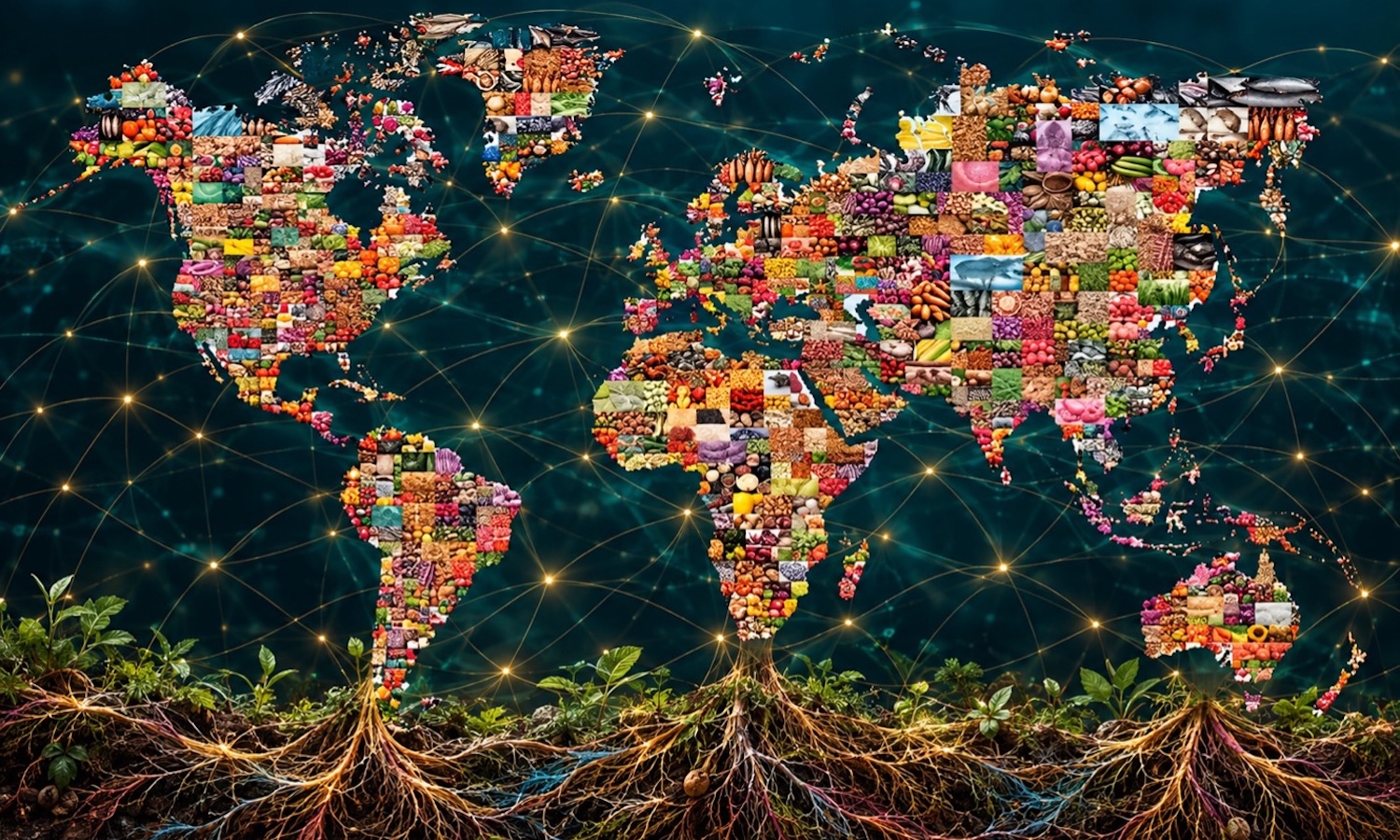
In a Nature Food comment, my colleagues and I drew inspiration from mangroves, whose resilience depends on diverse, interconnected root systems. Food systems likewise depend on interconnected agricultural systems, economies, governance, diets, and knowledge. To change what our food systems deliver, we must transform their foundational roots: what they are designed to achieve, what they reward, and how success is measured. When we prioritize yields and nutrients, we risk overlooking the many dimensions of nourishment. What we measure shapes what we manage, and what we incentivize shapes what we produce.
Imagine agricultural landscapes where biodiversity flourishes alongside productive farms. Where agricultural success is measured not only by yield per hectare, but also by food quality and its potential to nourish people. Where farmers are rewarded for nourishing people and regenerating ecosystems. Where diverse food economies thrive, food waste declines, and innovations emerge. Where healthier diets help reduce the trillions of dollars in health and economic costs associated with poor diets, and healthier people realize their full potential. Where nourishing food is desirable, accessible, and rooted in culture and choice.
This vision must extend to every community across the planet. Nourishment is a universal ambition, and its expression must reflect the diversity of people and places. Realizing it requires cooperation across agriculture, environment, economic development, health, and education. This ambition must continue to evolve, drawing on the world’s diversity of knowledge, cultures, and capabilities. The world of 2050 will not be the world of 2100.
This World Food Day, I am honored to join global partners through The Periodic Table of Food Initiative (PTFI) in advancing the ambition to nourish the world. Our contribution to this global call is to enable a growing global ecosystem to generate, integrate, and translate standardized molecular evidence on food and health that can accelerate food systems innovation to nourish people and the planet. Together, we are expanding the extraordinary frontier of food and health discovery.
Through PTFI, we are generating evidence across a remarkable spectrum of food systems innovations, from ancient crops grown using regenerative agricultural practices to entirely new classes of food products. We are collectively advancing our understanding of what this evidence means for human health. AI-enabled molecular modeling is helping generate hypotheses about how food molecules interact with human biology. We are connecting molecular evidence with existing epidemiological studies to investigate relationships between food quality and health, while conducting experimental and clinical research to test biological significance. However, we have only begun to scratch the surface of what remains to be discovered.
The path ahead calls for greater collective effort and investment to scale this work and translate emerging evidence into new approaches for characterizing and scoring food quality, as well as evidence-based recommendations and thresholds that can strengthen national and international food and health guidelines. Equally exciting is the opportunity to create entirely new markets and inspire a new generation of innovation. Imagine the possibilities unlocked by molecular evidence on food and health: creating new nourishing products, reimagining food procurement, and transforming how we understand, value, design, manage, and reward food systems.
Along this journey, we must recognize and value traditional knowledge while upholding Indigenous Data Sovereignty, equitable data access, and principles of Access and Benefit Sharing (ABS), ensuring that innovation does not come at the expense of the communities whose knowledge and resources make it possible.
Building on The Rockefeller Foundation’s pioneering investment in PTFI, alongside investments from other philanthropic partners, we have an extraordinary opportunity to meet the moment by mobilizing new and creative forms of capital to accelerate discovery and innovation for the future we want food to make possible.
Just as words expand our ambitions, new ambitions may call for words we have yet to imagine.
From surviving to thriving. From conserving ecosystems to regenerating them. From extending lifespan to fostering healthspan. From feeding the world to nourishing it.
This essay is part of Food Tank’s Flourish Series: Food and Health from Molecules to Systems, authored by Selena Ahmed, exploring how food connects us to the living world while asking what it means to flourish. For more in the series, click here.