Farmers across the U.S. are facing mounting economic pressures alongside the growing impacts of climate change. More than half of farms had negative income in 2024, while extreme weather disasters cost farmers billions, in addition to new tariffs and soaring input costs, and rising land prices threaten access for the next generation.
Supporting viable farms and ranches is essential to strengthening rural communities and building a more resilient food system amid these challenges.
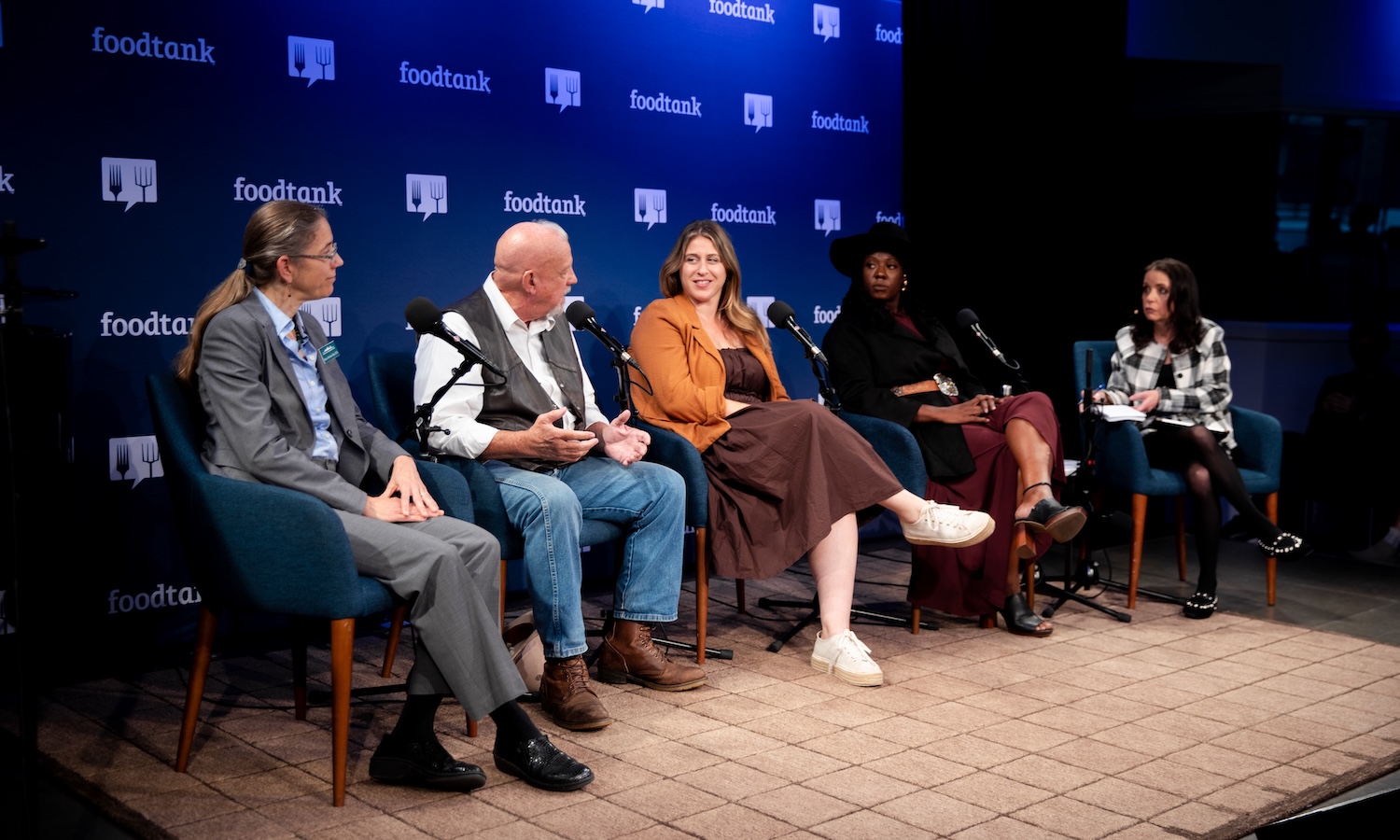
“Farmers cannot carry the climate transition alone,” Food Tank President Danielle Nierenberg said during “Thriving Farms and Ranches,” a summit held in partnership with the American Farmland Trust at Climate Week NYC. You can watch the entire event stream here.
“If we want healthier soils, if we want cleaner water, if we want to protect biodiversity, if we want nutritious food, if we want thriving rural communities, then we have to build an economy that rewards the people making those outcomes possible,” says Nierenberg.
Throughout the morning, speakers discussed how agriculture can help address climate change while ensuring the people who grow our food have the resources to thrive. A central theme emerged across conversations: Climate solutions must also support the economic well-being of farmers and rural communities.
“Even though more and more farmers are eager to follow regenerative practices, none of that makes much of a difference if farms are going out of business,” says John Piotti, President and CEO of American Farmland Trust.
Piotti highlighted the connection between farm profitability and environmental stewardship. While agriculture plays an important role in climate solutions, farmers need economic stability to sustain those efforts.
“Ultimately we need to pay farmers adequately not only for the food that they grow but for the ecological services they provide,” says Piotti. American Farmland Trust’s new Thriving Farms and Ranches initiative focuses on strengthening the economic viability of farms and ranches alongside their environmental contributions.
The economic challenges facing farmers also affect who can access land and continue farming. During a panel on farmland access for a new generation, Brooks Lamb, Director of Food Systems and Agriculture Policy at Vanderbilt Policy Accelerator, described rising land values and growing barriers for young farmers.
“In a lot of communities across the country, land values have skyrocketed…Sometimes even $40,000 an acre, in part because of real estate development,” says Lamb. “We’re seeing a lot of rural gentrification.”
Dominick Grant, Partner and Managing Director of Dirt Capital Partners, says land ownership is critical to supporting farmers’ long-term investments: “Land ownership is the foundation upon which everything is built…the ability for a farmer to invest in regenerative practices, their community, and a rural economy.”
Olivia Fuller, a fourth-generation farmer at Fuller Acres, points to another way communities can help sustain local farms: simply building relationships directly with farmers. “Find out who the farmers are in your community that you can support. Build relationships, show up at the farm for events…We need more of that.”
Speakers also explored how women farmers, local procurement, and farm-to-school programs can strengthen food systems. Hillary Barile, Owner of Rabbit Hill Farms, says farmers often want to make sustainable decisions but must balance those choices with economic realities.
“Every farmer that I’ve ever met wants to make the more sustainable choice that they can for their farm…but they have to balance those decisions with economic sustainability,” says Barile.
For Heather Oppel, Senior Climate Manager at General Mills, climate and agricultural solutions must also reflect the communities implementing them. Women comprise more than one third of U.S. agricultural producers, yet they face persistent systemic barriers in securing loans, land access, and technical assistance.
“Regenerative agriculture and women go hand in hand,” says Oppel. “In order to make this transition durable, it needs to be locally relevant.”
State policies also can—and must—help farmers respond to climate pressures.
“Our farmers are experiencing the impacts of climate change every day,” says Amanda Beal, Commissioner of the Maine Department of Agriculture, Conservation, and Forestry. “We are in a drought…we are seeing the impacts of extreme weather events, soil erosion, rivers flooding fields.”
And local procurement is a powerful way for institutions to support farmers, economic development, and children’s health: The school cafeteria is America’s biggest restaurant.
“Local procurement supports farmers and local economic development. Kids eat it, and therefore they will be healthier,” says Karen Ross, Secretary of the California Department of Food and Agriculture. “And there’s experiential learning. The children are connected with nature and understand how farming and nature can be compatible.”
Farm-to-school programs offer another way to connect farmers, communities, and the next generation. Kat Taylor, Chair of the Board of Directors at TomKat Ranch Educational Foundation, says California’s universal school meals program success demonstrates how quickly food systems can shift when investment and political will align.
“It’s not just the morally right thing to do for kids,” says Taylor. “It was also the right thing to do for the supply chain to shift it in favor of ecological and racial justice.”
Much of the work of ecological regeneration happens below the ground, in the soil. Ranchers joined the stage to speak about the realities of regenerative grazing, and how ranching can support soil health while strengthening rural economies and communities.
“The bounty is so great from the soil…and the economic impact. Our whole town is thriving,” says Will Harris, Owner of White Oak Pastures.
Finally, the program looked toward the next generation of eaters and farmers.
Access to land, economic viability, and opportunities to learn remain critical challenges to the next generation of farmers. But without more young people farming, the industry faces further consolidation or development that takes farms out of production and negatively impacts rural communities.
Connecting young people with farming and the natural world can help get children and young people excited about agriculture, says Jeff Tkach, CEO of Rodale Institute: “What gets kids excited is the world of soil. There’s a world beneath our feet…we only know about 5 percent of what we believe there is to know about it.”
And it’s working, says Deydra Steans, Manager of S3 Legacy Ranch—though young farmers still need much more education and support.
“There’s a trend. More young folks wanting to return to the farm,” says Steans.
Explore the entire Food Tank event schedule during Climate Week NYC 2026, and live-stream every Summit on FoodTank.com and Food Tank’s YouTube channel.
Articles like the one you just read are made possible through the generosity of Food Tank members. Can we please count on you to be part of our growing movement? Become a member today by clicking here.
Photo by Ryan Rose for Food Tank.