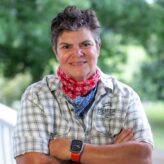
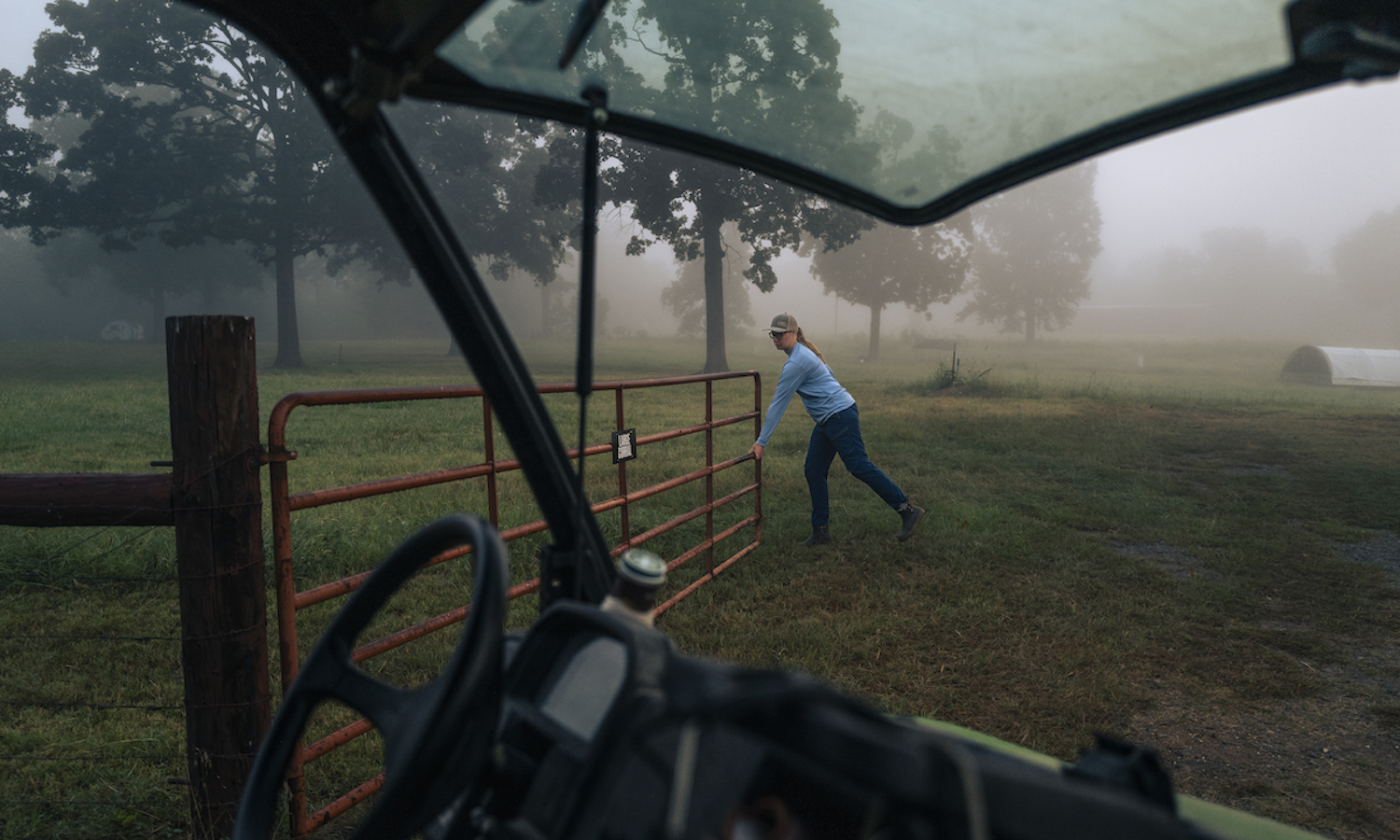
It’s early morning outside Perryville, Arkansas. A scissor-tailed flycatcher is perched on the fence, cattle are grazing in the bottoms, and Sam Noble begins her day in the chicken brooder at the Heifer Center for Regenerative Agriculture.
There is nothing unusual about a woman starting her day this way. Women have always farmed. They have raised livestock, managed farms, saved seed, sold food and cared for the land. What has changed is that we are finally getting better at seeing them.
That visibility matters.
Sam is Heifer USA’s Poultry Coordinator, and she is part of a growing number of women farmers and ranchers across the United States. Since 2002, the percentage of women producers has increased steadily. According to the USDA, women represent over 36 percent of all U.S. producers.
Some of that increase is about how we count. In 2012, the USDA changed the way it collected census information, allowing farms to identify more than one primary operator. That simple change made women’s contributions more visible in the official numbers.
But the numbers are catching up to something many of us working in agriculture have known for a long time: women are already doing the work… and have been doing so for a long time.
Being counted is one thing. Being recognized is another. Even today, Sam and the other women livestock managers at Heifer USA encounter the assumptions that come with being women farmers. Sam’s response isn’t to try to prove that she can farm like a man.
“To me, being a woman farmer doesn’t mean proving that I can farm like a man. It means I get to define what a good farmer looks like.”
Agriculture doesn’t need women to change who they are. The world needs to make room for different ways of knowing, different approaches to managing land and livestock, and different concepts of what a successful farm looks like.
The critical role rural women play in agriculture is evident across the Americas, and it is important to hear their voices. We recently spoke with women farmers in parts of Ecuador, Honduras, and Mexico.
Their stories are different because their circumstances are different. But the common threads and challenges are there. Access to land and markets, the effects of a changing climate, the importance of family and community. These women are making their way even if the systems around them don’t make it easy.
In the Sierra Madre de Chiapas, Mexico, land is never just land. Yumara Salas Ramírez is helping raise the visibility of women coffee producers. Chiapas produces 41 percent of Mexico’s coffee, but women hold only about a quarter of the land rights. Women also face challenges that range from sexism and violence to the effects of a changing climate.
At the Sierra Azul Cooperative, Yumara is the first woman to serve as the cooperative’s secretary and handles incoming green coffee. But she also works with women producers to market coffee under their own brand.
Yumara remains connected to the land and to the knowledge passed down through her family: “Every time we work with coffee, we reflect what we were taught and keep a family tradition alive.”
On the Galápagos Islands, part of Ecuador, over half of the food consumed is shipped in from the mainland. For an ecosystem as fragile as the Galápagos, that dependence creates its own problems, including the introduction of invasive plants and pests.
María Espinoza is using agroecological methods to raise livestock and grow crops for local markets on land cleared of invasive blackberry bushes. She and other farmers have increased the percentage of locally sourced food available at their market from 10 percent to 40 percent since 2019. It is an example of how local food production can play multiple roles: providing income and strengthening food sovereignty.
María doesn’t pretend the work is easy: “The most difficult part? There isn’t one. With dedication, you just have to overcome the difficult challenges.”
The challenges these women face vary, but one issue affects them all: a changing climate. Women farmers are particularly vulnerable to climate impacts. They often have fewer resources available during droughts, extreme weather or other disruptions.
Milexy Rodriguez, a farmer in El Nance, Honduras, lost 15 of her cattle during a drought in 2024. It was a call to action to build a more resilient livelihood. With support from a community savings group, she drilled a well and diversified her production, growing chili peppers and keeping bees.
Milexy’s experience is a reminder that resilience isn’t some abstract concept. It may be a well, or another crop, but sometimes resilience is challenging assumptions about who belongs in agriculture.
“Many people thought that a woman couldn’t manage a cattle farm. However, with consistent work, I’ve proven that it is possible.”
Working at the Heifer Center for Regenerative Agriculture, I get to see women like Sam doing this work every day. I see it in the way our entire livestock team cares for the animals, makes land-use decisions, and tries new things.
And I see something else, too.
The women I know in agriculture aren’t waiting for someone to tell them they belong. They are already doing the work. That is what struck me as I learned more about these women across the Americas. All of our farms and lives vary, but the underlying questions are familiar.
How do we care for the land and still make a living?
How do we pass knowledge on to the next generation?
How do we build communities and food systems that can withstand difficult times?
For too long, women have had to answer these questions while also proving that they belong at the table. The most important change is that we are noticing what has been happening all along. Women have been farming, ranching, building markets, raising families and caring for the land for generations.
The numbers are finally catching up with that reality. And that is a good thing. If we are serious about building resilient farms and food systems, we need the knowledge, experience and leadership of everyone.
Articles like the one you just read are made possible through the generosity of Food Tank members. Can we please count on you to be part of our growing movement? Become a member today by clicking here.
Photo courtesy of Lys Arango / Heifer International