
A version of this piece was featured in Food Tank’s newsletter, typically released weekly on Thursdays. To make sure it lands straight in your inbox and to be among the first to receive it, subscribe now by clicking here.
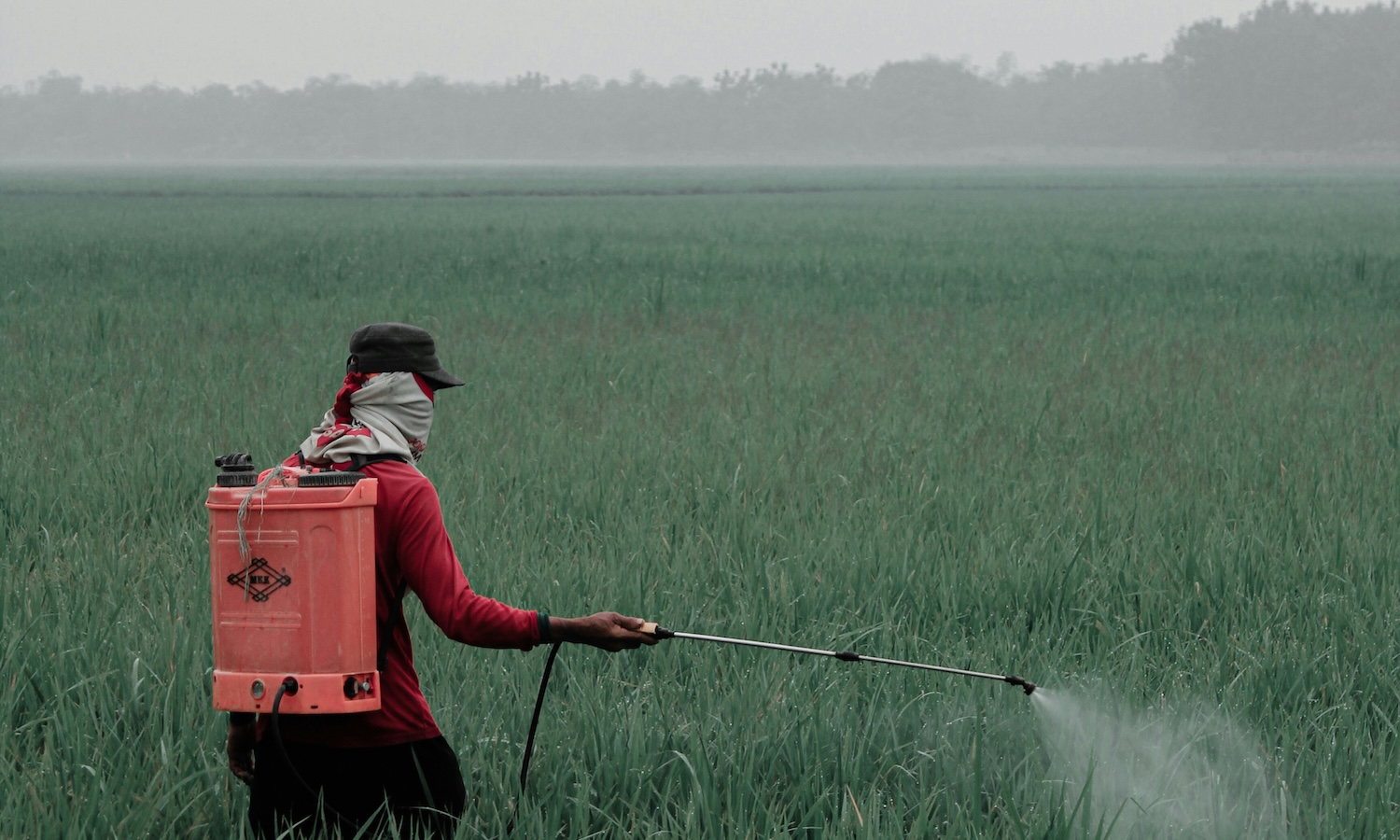
I want to share a fact that should blow us all away: According to the U.N. Food and Agriculture Organization (FAO), global pesticide use has just about doubled since 1990.
This is already quite worrying—but I’m even more concerned by the question of where we’re headed from here.
Amid a warming global climate, some pest problems are getting worse, not better. In hotter conditions, pests can reproduce faster, sometimes adding a generation or more per growing season, which can make them more virulent and damaging. A team of international biology researchers projected that, under 2ºC of warming, increased pest damage could drive additional yield losses of 46 percent for wheat, 19 percent for rice, and 31 percent for maize.
And we can’t sustain more significant increases in pesticide use to compensate—because the health consequences simply cannot be ignored. Chronic exposure to these synthetic pesticides is linked to a variety of health issues from cancer to Parkinson’s disease, plus other endocrine disruptions and neurological issues. These chemicals are also devastating for biodiversity, threatening a variety of bird, bee, and other insect populations that are integral to the health of our food and climate systems.
At the same time as we’re seeing these ballooning rates of synthetic pesticide use, we have an off-ramp out of this downward spiral. We just need to use it.
As part of food production and land management models rooted in agroecology—including regenerative practices like cover cropping and rotation and policy structures that support climate-smart, biodiverse, community-centric farming—what really deserves more attention are biopesticides, which are derived from natural sources including bacteria, plants, animals, and certain minerals.
This makes them “inherently less toxic than conventional pesticides,” according to the U.S. Environmental Protection Agency (EPA). Rather than conventional pesticides that affect a broad spectrum of organisms, biopesticides are generally more targeted, are able to be applied in much smaller quantities, and decompose much more quickly and cleanly without necessarily affecting crop yields.
And this is not theoretical—it’s proven on the ground. Across Africa and Asia, for example, the International Crops Research Institute for the Semi-Arid Tropics (ICRISAT) is using microbial biopesticides to control pests like the cotton bollworm.
“This is not just science in the lab. It’s innovation in the hands of farmers,” says Dr. Stanford Blade, the Deputy Director General for Research and Innovation at ICRISAT. “By working with nature instead of against it, we’re helping smallholder farmers build resilience against droughts, restore biodiversity, and grow healthier food.”
Like any solution, biopesticides are not perfect. Regulatory hurdles, skepticism from farmers, and challenges accessing the products themselves are all factors that are interfering with or slowing the adoption of biopesticides, according to analysts. Price is, too: While we know sustainable practices make better business sense long-term, we need to work to improve the immediate affordability of some of these techniques.
But as the International Centre of Insect Physiology and Ecology (icipe) is showing, public-private sector partnerships are effective at developing biopesticides and educating farmers to encourage their use.
“Globally, the replacement of synthetic pesticides with biological alternatives is seen as an ideal strategy towards sustainable agriculture and the conservation of biological biodiversity,” the organization’s experts say. I’m excited that I’ll be visiting icipe in early April as part of my ground-truthing work to document the impacts of the dismantling of USAID.
Building meaningful and effective partnerships between big players in the plant science industry, policymakers, and small-scale farmers and advocates is exactly what I had the opportunity to talk about this week on the Food Talk podcast with Emily Rees, the President & CEO of CropLife International.
It’s a nuanced conversation I hope you’ll check out, and one thing she and I agree on is the importance of what she called “radical collaboration”—giving everyone not just a seat at the table but also real decision-making power, because what affects one part of the food system affects us all.
As she phrased it, “If you’re not listening to the ground as to what the farmers want, then it will be difficult to respond to that in the international policy sphere.” Give the whole episode a listen or watch below.
Over the past week, at Summits in Austin, Texas, during SXSW and in Boston for our inaugural Blue Foods Summit, we’ve handed over our stages to farmers for evenings of authentic storytelling and films like Food Tank’s debut original documentary short “Irish Farmers: A Love Story.” I want to extend a huge thank you to all the Food Tankers who joined us in person and via livestream this month!
I can’t lie: I get emotional hearing farmers of all ages and backgrounds speak so powerfully and emotionally about their connections to the land. But there’s no question that these are fully tears of joy and hope. When we let passionate farmers and regenerative ethics and sustainable steps—like biopesticides rather than synthetics—lead the way, our future is in good hands.
Articles like the one you just read are made possible through the generosity of Food Tank members. Can we please count on you to be part of our growing movement? Become a member today by clicking here.
Photo courtesy of Ilham Wicaksono, Unsplash