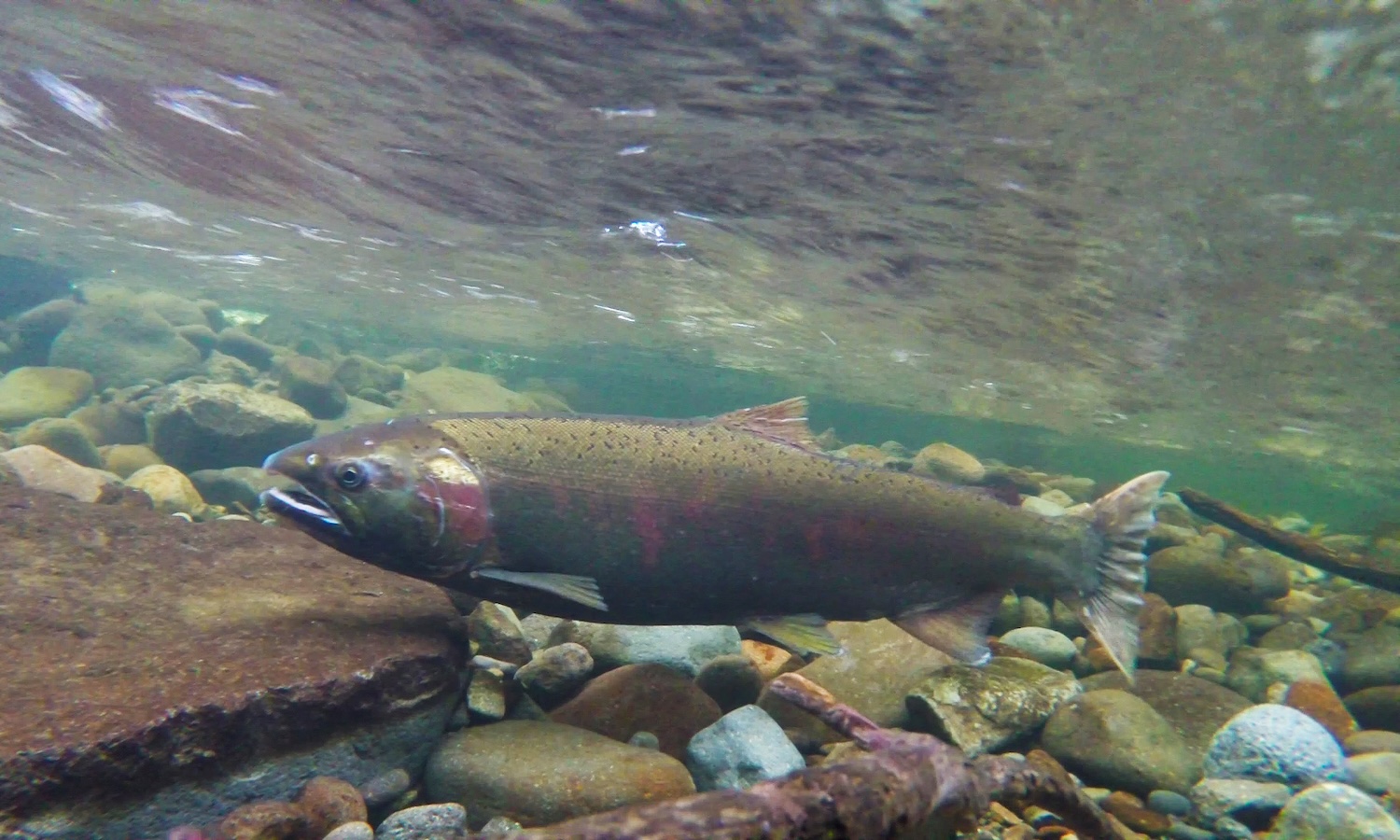
Researchers from the Scholes Lab at the University of British Columbia (UBC) worry that a newly identified tire toxicant is threatening coho salmon populations. They’re now working to determine which streams and rivers are most affected.
As part of the STREAM (Salmon Toxic Runoff Exposure and Mitigation) project, an inter-disciplinary group of researchers are developing a model to identify which streams and rivers are most vulnerable to the toxicant, known as 6PPD-quinone. In parallel with identification, the project works to design ways of removing the toxicant from stream runoff before it reaches salmon waters.
A study published in Science identified the compound 6PPD-quinone, an oxidation product of an additive intended to prevent damage to tire rubber, as a leading cause of toxic mortality for coho salmon in the Pacific Northwest.
Zhenyu Tian, a Chemist at Northwestern University and a lead author on the study, tells Food Tank that eventually the mortality of coho salmon could reduce the fishing supply for consumption.
STREAM researchers measured the levels of 6PPD-quinone before, during, and after rainfall across 10 sites deemed vulnerable due to their proximity to large highways, explains Tim Rodgers, a Postdoctoral Fellow at UBC. There were high levels of the toxicant in coho salmon, “almost every time it rained, in almost every stream we measured,” Rodgers says.
But the researchers discover that rain gardens, which capture and collect 6PPD-quinone from road runoff and filter it out via soil contraptions, can prevent the toxin from contaminating streams.
“Right now we treat our streams as storm sewers,” Rodgers tells Food Tank. “What I would love to see is us treating more of that water through these systems.” He adds that bringing green infrastructure systems, like rain gardens, into more places has an added benefit of providing more urban green space for city residents.
According to the Government of Canada, British Columbia has made significant investments in green infrastructure as a strategy for disaster mitigation, but Rodgers says it’s important to prioritize places with known populations of coho salmon.
The streams and riverbanks located by coastal First Nations’ reserves are of particular concern to researchers. Rodgers says the Scholes Lab’s collaboration with the Tseshaht First Nation helped identify these areas as being most vulnerable to declines in coho salmon, due to their proximity to large highways that run through the reserves. Salmon are one of the First Foods for First Nations along the West Coast and play an important food source for these communities, according to NOAA Fisheries.
And coho salmon aren’t the only species threatened by 6PPD-quinone. According to Tian, 6PPD-quinone is also toxic to steelhead and coastal cutthroat salmon, manifesting in similar symptoms to coho, though it’s not as deadly. Surrounding habitats may be at risk as well.
“We know now that there are sub-lethal and chronic toxicity issues,” Rodgers tells Food Tank. “People have seen some phototoxicity, so plants are being impacted.”
In an effort to reduce the harm to habitats, researchers on the project are advocating to reduce exposure to toxicity at large. They released a policy piece calling for improvement in the safety— and transparency—of chemicals used in tires.
Rodgers hopes to see more attention paid to the detrimental effect of toxic runoff in Pacific Northwest waters. “Salmon transport nutrients and fertilize the ocean and rivers they return to, and all of us depend on healthy rivers and watersheds,” NOAA Fisheries says.
“Salmon are just these big charismatic species that feel like a really big part of the general culture of the West Coast,” Rodgers tells Food Tank. “They also bring tons of nutrients up into the food web.”
Articles like the one you just read are made possible through the generosity of Food Tank members. Can we please count on you to be part of our growing movement? Become a member today by clicking here.
Photo courtesy of the Bureau of Land Management Oregon and Washington, Wikimedia Commons