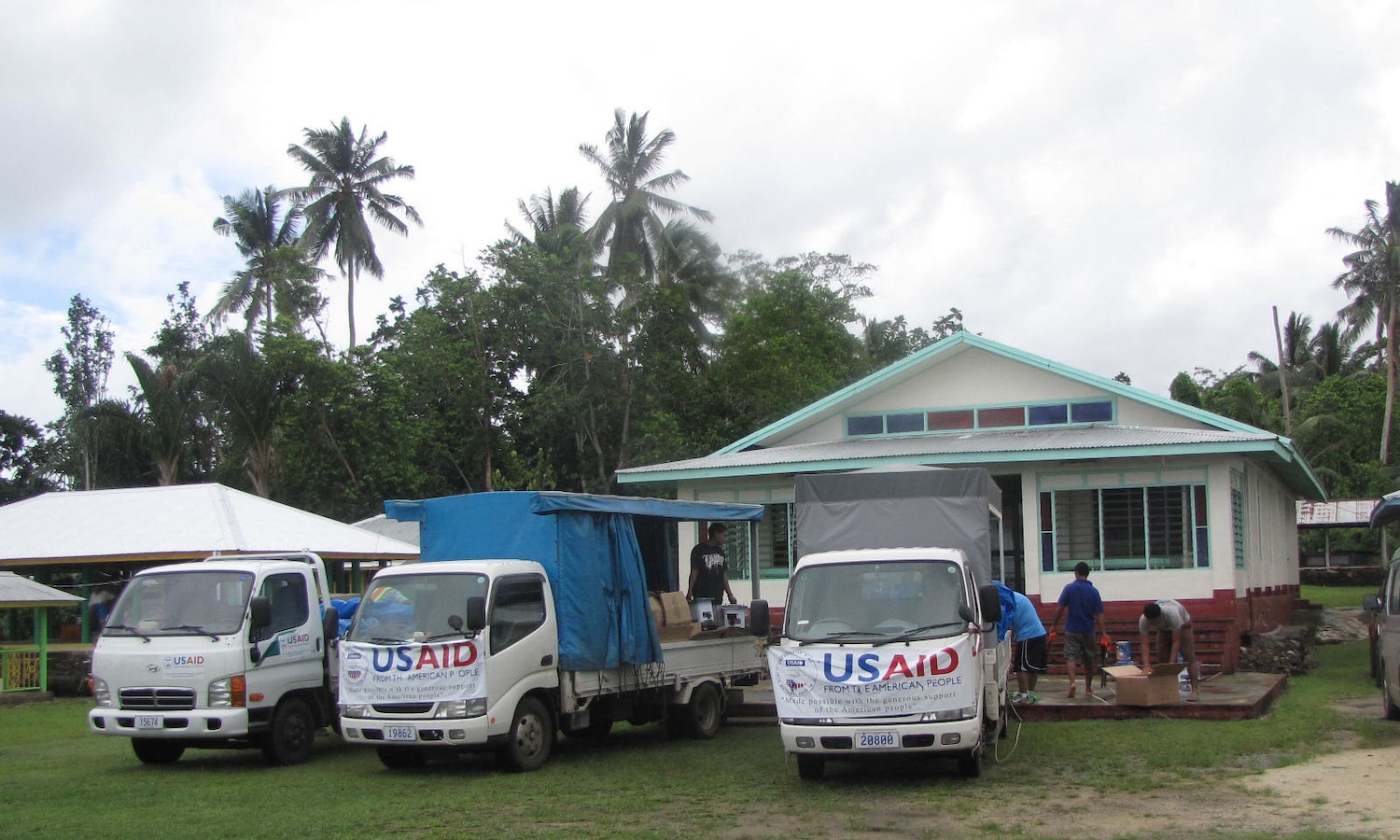
A new book by former civil servant Nicholas Enrich offers an insider’s account of the dismantling of the U.S. Agency for International Development (USAID)—and the steps he took to speak out against the destruction.
During the early months of the Trump-Vance Administration, USAID was the target of funding freezes, program cancellations, staff layoffs, and more. Federal officials said they were “clearing significant waste, before the agency officially shuttered in July 2025. But Into the Wood Chipper: A Whistleblower’s Account of How the Trump Administration Shredded USAID paints a different picture.
“The agency was dismantled, not because it was wasteful, not because it wasn’t working or inefficient or to better align foreign aid with the President’s agenda,” Enrich tells Food Tank. “It was demolished by a group of uninformed and unqualified sycophants who were working to satisfy the ego of the world’s richest man.” He says he needed to write this book to set the record straight and explain what really happened.
Enrich worked at USAID under four administrations, most recently serving as Acting Assistant Administrator for Global Health. Like any institution, there were ways that USAID could operate more productively, he believed. And before officials from the Department of Government Efficiency (DOGE) arrived, he optimistically prepared a list of ways he thought he could be helpful.
But within a couple of weeks, it was obvious to Enrich that DOGE wasn’t interested in making the agency operate better. The tipping point, he says, is when Elon Musk posted on X in early February that the government had “spent the weekend feeding USAID into the wood chipper.”
Just a day before, Musk also called the agency “a criminal organization”—a statement that Enrich says was painful to hear. “I thought there was a certain valor in dedicating your career to public service,” he tells Food Tank. “You felt like this is a country that you want to make better, that you’re willing to make that sacrifice….It was a calling.”
After this, Enrich watched with alarm as life-saving aid was eliminated. Programs to tackle infectious diseases like HIV/AIDS, tuberculosis, and malaria and support maternal and child health were canceled overnight.
“I think people have been focusing a lot on the impacts that have already happened, and they have been enormous,” Enrich says. But it’s the impact on future generations that “really keeps me up at night.”
Enrich and colleagues began to document what was happening, which he compiled into three memos. The first tracked every effort he and others made to re-start the agency’s work and the roadblocks they encountered at every step of the way. The second focused on the destruction of the workforce “that made it impossible to do our work even if we had been allowed to,” Enrich says. The third highlighted the extent of the damage, based on modeling and projections from technical experts.
Enrich knew that distributing these memos publicly would cost him his job, but by that time DOGE was terminating contracts needed to continue USAID’s work. “Once it became clear that’s where we stood, I realized that I was not going to be able to fix this from within,” Enrich tells Food Tank. “And my silence, if I continued, would really be complicity.”
Listen to the full conversation with Nicholas Enrich on Food Talk with Dani Nierenberg to hear more about what made USAID so vulnerable, the impact of the agency’s closure on local communities, and the advice he gives to anyone in a situation like his.
Articles like the one you just read are made possible through the generosity of Food Tank members. Can we please count on you to be part of our growing movement? Become a member today by clicking here.
Photo courtesy of U.S. Embassy Apia, Samoa