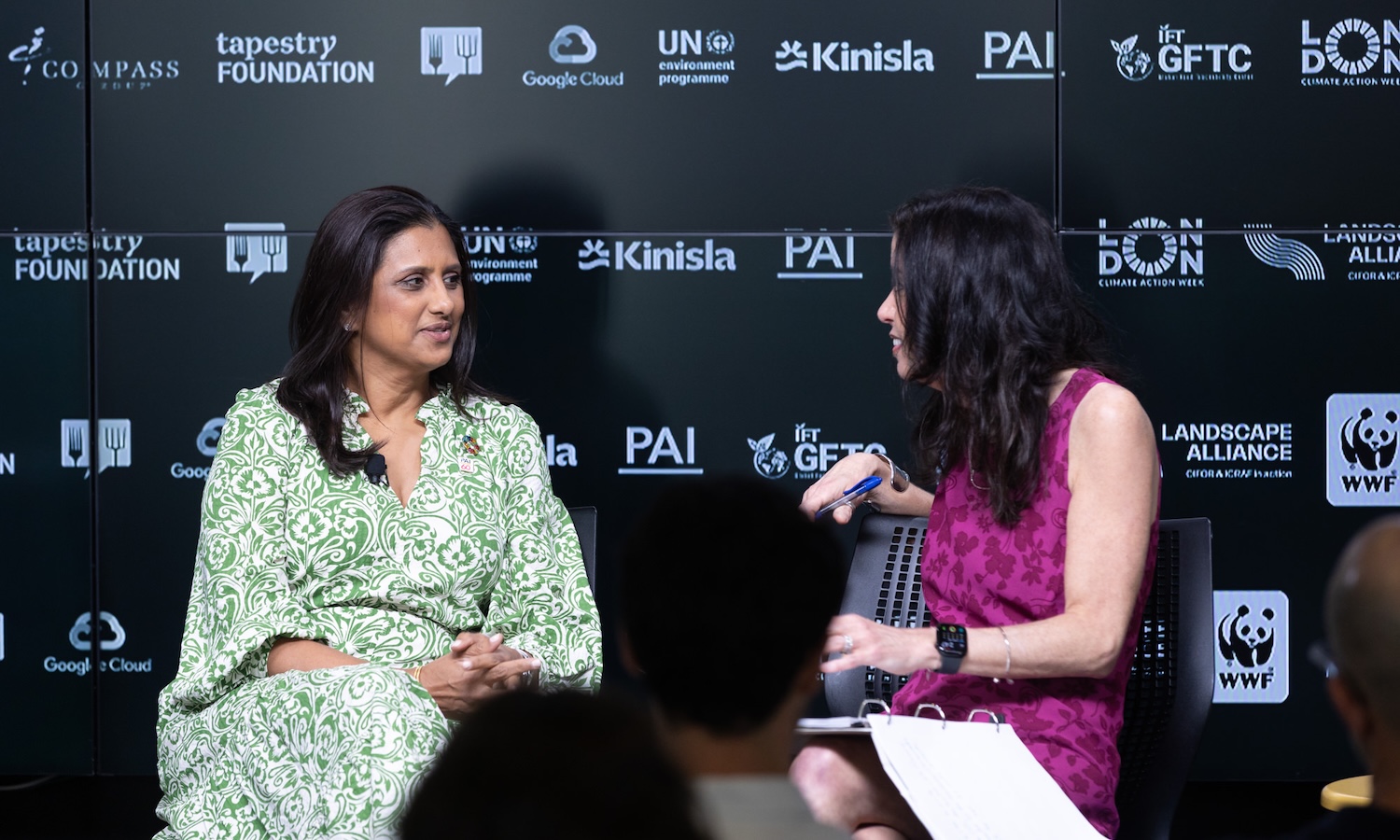
The withdrawal of foreign aid globally is posing new challenges to women’s health around the world. During Food Tank’s 3rd Annual Chief Sustainability Officer and Food Systems Funders Summit, Nabeeha Kazi Hutchins, President and CEO of PAI, argued that this directly impacts the sustainability of food and agriculture systems—and the businesses working to build resilient supply chains.
The London Climate Action Week event was hosted in partnership with Google Cloud, Compass Group, the U.N. Environment Programme, PAI, Landscape Alliance, Kinisla, Tapestry Foundation, Alliance of Bioversity International and CIAT, WWF, Strong Roots, and the Institute of Food Technologists.
Women account for close to half of the workforce in food and agriculture globally. But their contributions aren’t always recognized. “We consistently overlook—or at least not center and bring forward—the role of women and how women are powering our food systems,” says Kazi Hutchins. And, she adds, “If we are saying women are central to food systems, women’s health is central to food systems.”
The decision from the United States and other nations to pull back on development assistance has had massive repercussions on the livelihoods of communities. But while it may threaten progress made on gender equity, “not all is lost,” says Kazi Hutchins. She believes that this disruption offers an opportunity to assess whether aid was designed in the right way.
PAI works with a large network of grassroots organizations in more than 35 countries. This includes many women- and youth-led groups that “consistently step up to the plate,” Kazi Hutchins says. These organizations are partnering with governments and other advocates, asking how to “sustainably feed, nourish, ensure the safety and security of women and communities, and do it on our own terms.”
The private sector can support these efforts by investing in the systems that uplift women and their communities. And they’re not the only ones who benefit, Kazi Hutchins notes, because it’s also good business.
“Your number one customer are women and your number one producer for those goods and services are also women,” Kazi Hutchins says, speaking to the brands in the room. “When you have healthy, vibrant societies, you also have healthy, vibrant women who can make decisions. That is securing your markets and that is continuing to supply the essential nutrition and food that the world needs.”
Watch the full conversation below:
Articles like the one you just read are made possible through the generosity of Food Tank members. Can we please count on you to be part of our growing movement? Become a member today by clicking here.
Photo courtesy of Shai Dolev for Food Tank