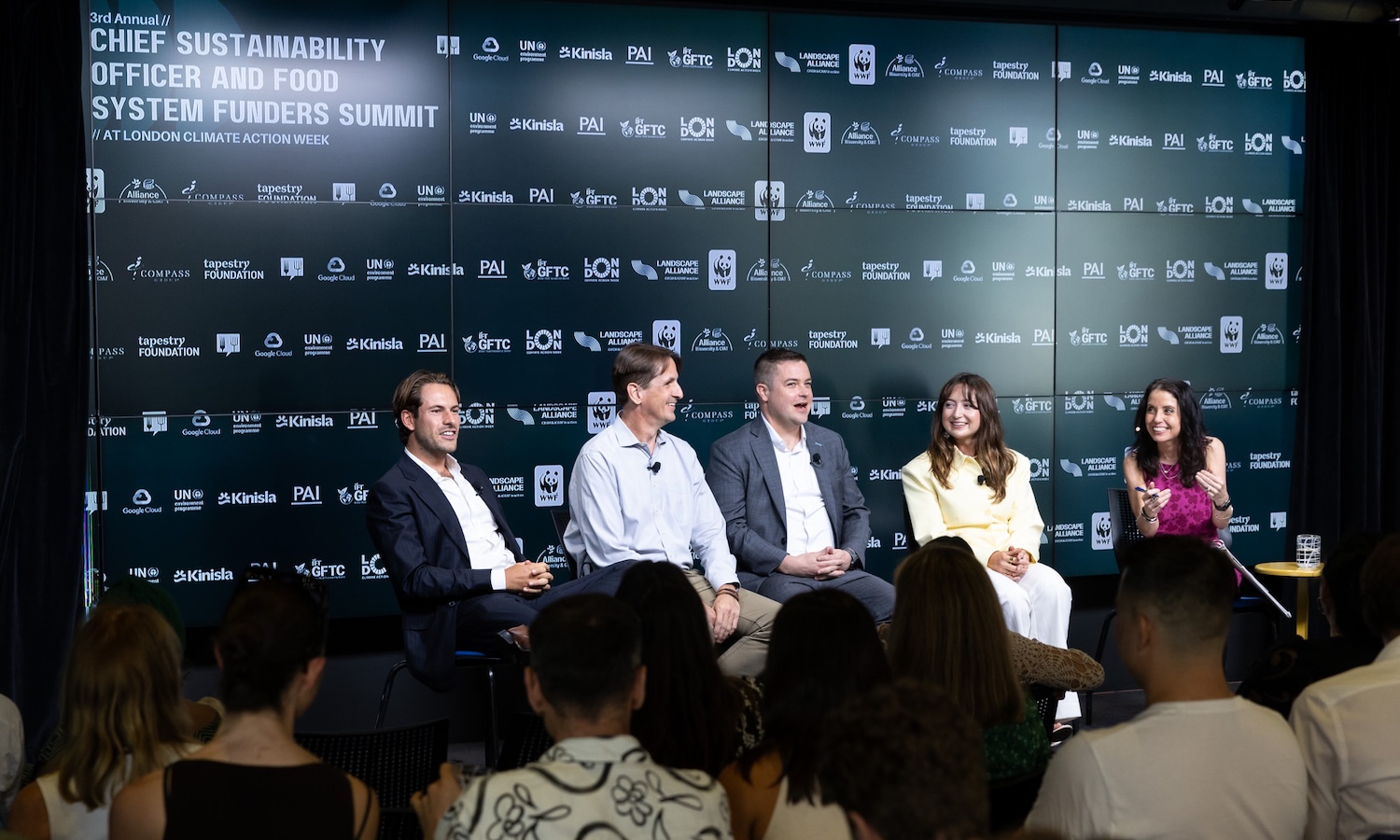
Technological advancements and new frameworks are bringing more transparency into food and agriculture supply chains. This empowers farmers and eaters while enabling climate action, panelists said during a conversation at Food Tank’s 3rd Annual Chief Sustainability Officer and Food Systems Funders Summit.
The London Climate Action Week event highlighted steps that food businesses, funders, researchers, and advocates are taking to make food and agriculture systems a primary solution to the climate crisis. It was held in partnership with Google Cloud, Compass Group, the U.N. Environment Programme, PAI, Landscape Alliance, Kinisla, Tapestry Foundation, Alliance of Bioversity International and CIAT, WWF, Strong Roots, and the Institute of Food Technologists.
For farmers like Sophie Bell, who is based in County Cavan, Ireland, traceable supply chains can offer real economic benefits. Using wool as an example, she explains that the lack of transparency makes it possible to advertise the product as Irish even if it’s been imported. And because imported wool is cheaper, it leaves Irish farmers with little incentive to sell what they could produce locally.
Bell says her own farm is currently deemed unprofitable, and she’s not alone. “That’s the reality for a lot of farmers in Ireland at the moment.” But if she could easily point to the full journey of the food and other products she produces, she suspects things would change. “It would set a whole new standard for agriculture in Ireland.”
Traceable supply chains can also encourage the adoption of more regenerative agriculture practices, says Fernando Bellese, Senior Director of Beef and Leather Supply Chains for WWF. If buyers know where their products are coming from and how they’re grown, it’s easier to invest in and support the producers who are doing right by people, animals, and the planet.
“More transparent supply chains will allow different sectors to better support farmers in their transition,” Bellese says. Now, he adds, they need brands and retailers to engage.
And panelist Blade Brink believes the desire is there. “A lot of companies want that traceable product, that traceable supply chain, but they don’t know how to communicate that across the entire industry,” says Brink, Product Operations Manager for Wholechain, a blockchain-based traceability solution.
That’s why the technological infrastructure is so key. The ideas of interoperability and standardization have become some of the most important topics in traceability conversations, the speakers say.
“As we look across food systems, there are hundreds of different softwares that are used to collect data, to share data,” says Blake Harris, Managing Director for the Global Food Traceability Center at the Institute of Food Technologists. “You also have to understand that a lot of parts of the supply chain rely on paper-based documentation.”
But if these documentation tools can speak to each other—even when they’re operated by different companies or come into play at different stages of the supply chain—it becomes much easier to trace a product from its source. Tools from organizations like IFT are making this possible.
What’s particularly exciting for speakers is that these new and emerging solutions are “commodity agnostic,” they say. These technologies can work not only for beef, seafood, or wool, but ultimately for all products across food and agriculture systems.
Watch the full conversation below:
Articles like the one you just read are made possible through the generosity of Food Tank members. Can we please count on you to be part of our growing movement? Become a member today by clicking here.
Photo courtesy of Shai Dolev for Food Tank