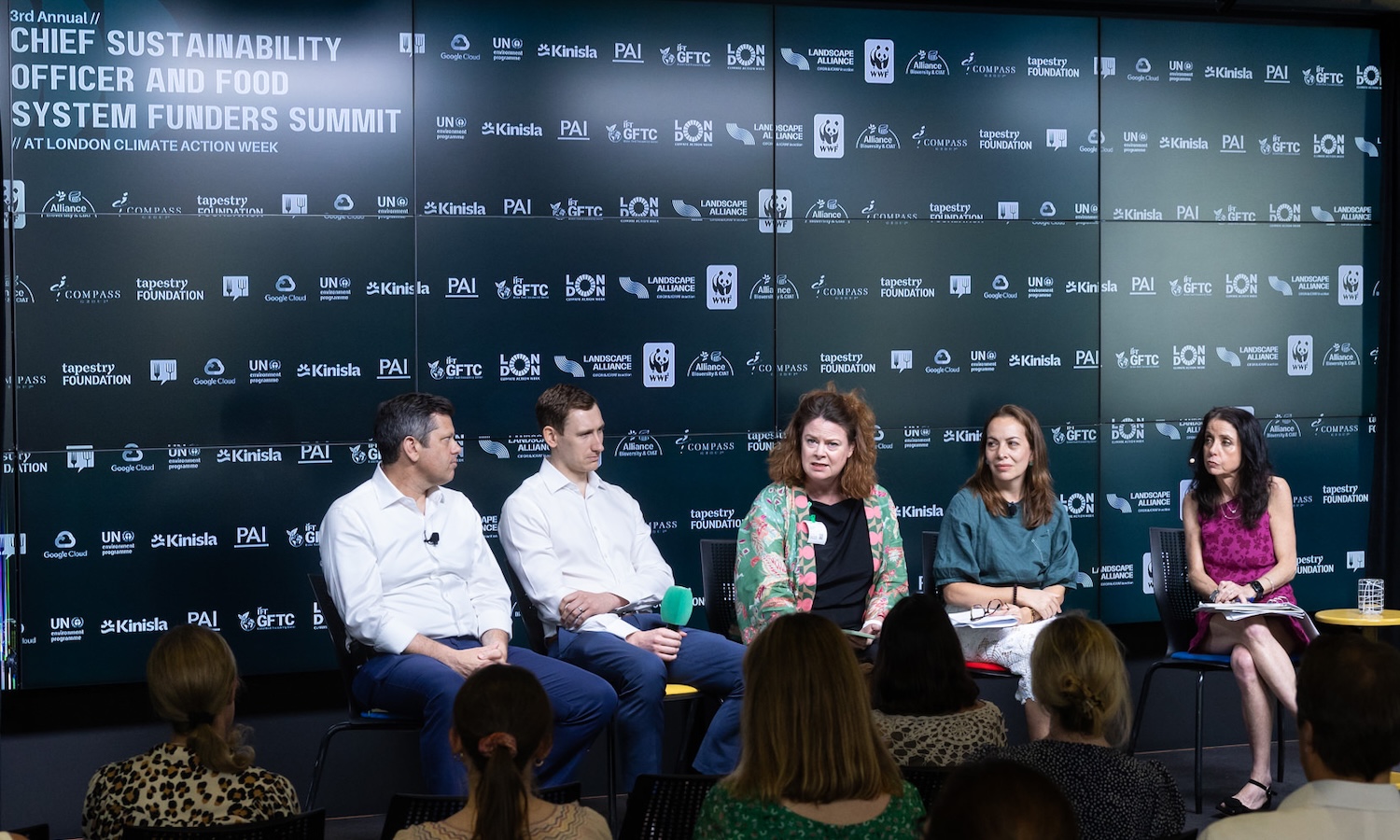
During Food Tank’s 3rd Annual Chief Sustainability Officer and Food Systems Funders Summit, panelists argued that protecting biodiversity and building climate-resilient supply chains are more than an environmental obligation, they are a competitive advantage.
The event took place during London Climate Action Week and was held in partnership with Google Cloud, Compass Group, the U.N. Environment Programme, PAI, Landscape Alliance, Kinisla, Tapestry Foundation, Alliance of Bioversity International and CIAT, WWF, Strong Roots, and the Institute of Food Technologists.
Improving biodiversity can build resilience against pests, diseases, and climate shocks. But around 70 percent of the world’s food supply comes from nine crops, says Stephanie Speck, the Global Director of Strategic Partnerships, Engagement and Communication at the Alliance of Bioversity International and CIAT. “If that is not a recipe for disaster,” she says, pointing to the immense vulnerabilities that this reality creates.
The private sector has an important role to play in climate solutions, and the Alliance wants to work with businesses that understand that biodiversity matters. This means finding companies that no longer believe “efficiency is king,” Speck says. Instead, they want partners “who see biodiversity as a source of competitive advantage.”
Marcela Quintero, Associate Director General for Research Strategy and Innovation for the Alliance, points to an example in Latin America. There, researchers are trying searching through seed banks to find a solution to a fungal infection plaguing bananas in the region. And with the private sector, they are working to unlock the funding needed to advance these efforts.
“We want to bring science into investment, not only funding into science,” says Quintero.
Companies like Danone are also leaning into partnerships to improve resilience. Their presence spans the globe, but efforts vary by country. In Morocco, for example, their network includes 30,000 smallholder farmers who “need access to capital, training, technical assistance, and help with the quality of the milk,” says Chris Adamo, the company’s Head of Global Sustainability Impact & B Corp. Working alongside communities, they’re able to help farmers build the capacity they need to thrive.
Increasingly, investors are understanding the value of sustainability initiatives as well, says Matthew Hewitt, the Sustainable Capital Markets Team Director at BNP Paribas.
Deforestation has become a primary focus for them, Hewitt explains. The compliance deadline for new EU Deforestation Regulations is approaching this year, and stakeholders who can already prove they meet the standards “are in a much better position.” This, he adds, “will be a major factor for global food chains.”
Watch the full conversation below:
Articles like the one you just read are made possible through the generosity of Food Tank members. Can we please count on you to be part of our growing movement? Become a member today by clicking here.
Photo courtesy of Shai Dolev for Food Tank