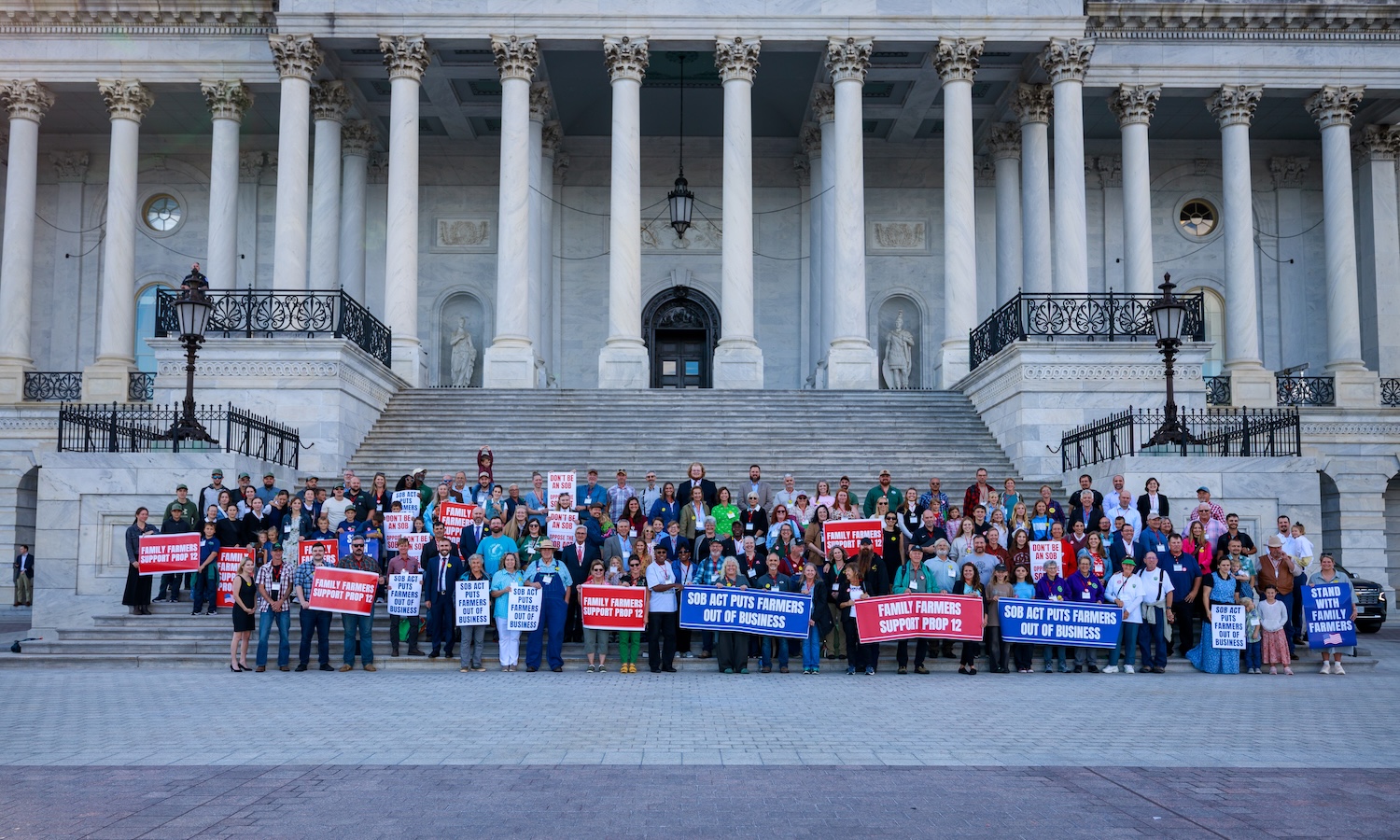
Animal welfare advocates are urging Congress to keep the Save Our Bacon Act out of the Senate Farm Bill, arguing that it threatens the wellbeing of livestock and harms small and mid-sized family farmers.
Introduced by U.S. Representative Ashley Hinson (R-IA), the Bill aims to prevent state and local governments from dictating the production practices of livestock producers in other states. Those in favor of the bill say that it would protect family farmers and interstate commerce. But opponents are concerned that it would overturn hundreds of existing animal welfare laws, harm independent farmers, and establish an unprecedented burden of federal overreach.
The Farm Bill, which passed the House in late April, is now under review in the Senate. Save Our Bacon threatens state animal welfare laws, such as California’s Proposition 12 (Prop 12) and Massachusetts’ Question 3, which were passed by 62.7 percent and 77.6 percent of voters, respectively.
Prop 12 and Question 3 “are really basic protections for farm animals; all they’re requiring is that if you want to sell products into those states, you can’t confine animals in cages and crates so small that they can’t turn around or extend their limbs,” Kara Shannon, Director of Farm Animal Welfare Policy at the American Society for the Prevention of Cruelty to Animals (ASPCA), tells Food Tank.
Supporters of Save Our Bacon deem these welfare standards to be “arbitrary mandates” made by “out-of-touch activists.” According to Wendy Brannen of the National Pork Producers Council (NPPC), which represents over 60,000 U.S. pork producers, opposition to Prop 12 is rooted in these “non-science-based” standards rather than animal welfare itself. She says, “animal welfare policy should be grounded in veterinary expertise, practical farm experience, and measurable outcomes,” in order to “keep our family farms in business.”
Supporters including Hinson and the NPPC also argue that legislation like Prop 12 creates a patchwork of laws that hinder interstate commerce, encourages industry consolidation, and exercises an overreach of state power.
But the American Meat Producers Association (AMPA), a coalition that represents American independent family farmers and meat producers, worries the Bill will have the opposite effect. “In reality, the Save Our Bacon Act would primarily benefit large China-owned pork corporations, not independent family farmers,” Holly Bice, President of AMPA, tells Food Tank. Smithfield Foods, which controls around one-fourth of all U.S. pork production, is owned by a Chinese company.
Bice believes that legislation like Prop 12 provides independent farmers with an opportunity to differentiate themselves. She says it allows farmers to create a viable market for higher-welfare products and compete against the large agribusinesses that currently dominate the industry. More than a quarter of pork producers have invested to become Prop 12 compliant to meet the demand for higher animal welfare standards, according to an analysis from the Harvard Law School Food Law and Policy Clinic.
Overturning Prop 12 would devalue these investments and “trigger a race to the bottom…that further entrenches the consolidated industrial system that we have,” says Shannon.
“If Prop 12 is preempted, it is just another signal from our policymakers that what they care about are the interests of a handful of multinational companies,” Anna Pesek, a pork farmer and leader of the Farmers for Animals, Communities, and the Environment (FACE) Ag Network, tells Food Tank. She adds that profits will flow out of rural communities, states, and even the country.
U.S. Senator Roger Marshall (R-KS) recently withdrew his support of the Senate’s version of the Save Our Bacon Act. It is still backed by more than half a dozen of his colleagues including Senator Chuck Grassley (R-IA). The Senate draft of the Farm Bill is expected to be released in June.
Articles like the one you just read are made possible through the generosity of Food Tank members. Can we please count on you to be part of our growing movement? Become a member today by clicking here.
Photo courtesy of the American Meat Producers Association