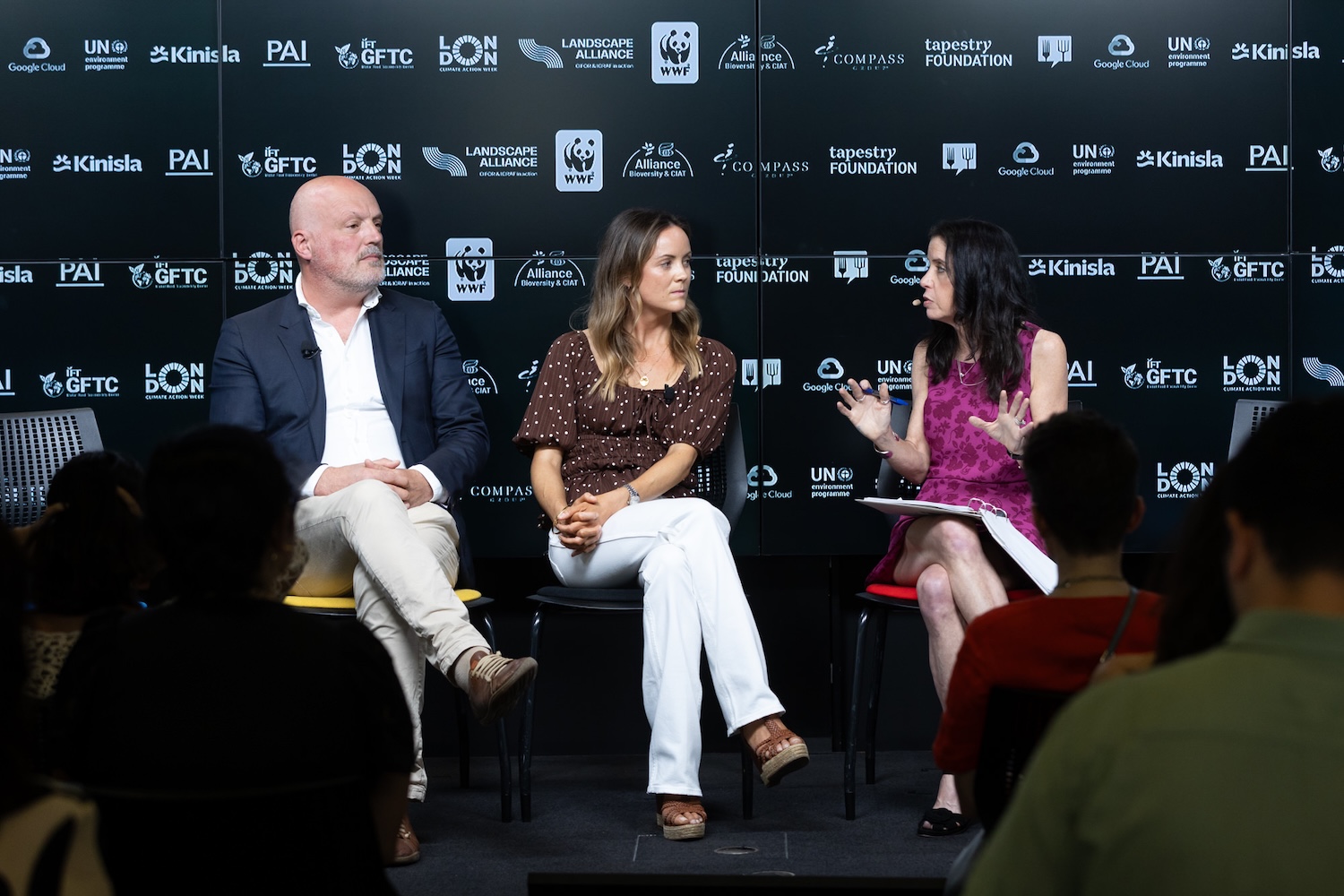
In Ireland, food brands are demonstrating that a commitment to farmers and sustainability is paying off. During Food Tank’s 3rd Annual Chief Sustainability Officer and Food Systems Funders Summit at London Climate Action Week, panelists explained how their models can stand as case studies for businesses around the world.
The event—hosted in partnership with Google Cloud, Compass Group, the U.N. Environment Programme, PAI, Landscape Alliance, Kinisla, Tapestry Foundation, Alliance of Bioversity International and CIAT, WWF, Strong Roots, and the Institute of Food Technologists—brought together more than 200 leaders from food business, philanthropy, and the investment sector to talk about solutions to shape a sustainable future for food and agriculture systems.
At the Irish dairy company Kinisla, the team realizes that their success starts with their producers. “Supporting farmers…is one of our highest priorities because it leads to a win-win,” says Richard Chute, Kinisla’s Chief Financial Officer.
As part of the company’s Evolve RegenDairy Program, they help milk suppliers implement practices that are better for animals and their land. They’re also taking steps to improve watersheds that farmers and their communities rely on. Chute explains that this brings Kinisla a competitive advantage, allowing them to differentiate their products as highly sustainable in the marketplace.
But it’s not just about the short-term wins; this work is intended to support a thriving food ecosystem for years to come. “We’re investing in their business and incentivizing them to ensure that their business is there to be able to hand the baton over to the next generation,” Chute says.
Strong Roots, a frozen food company also founded in Ireland, sees narrative as another piece necessary to keep these sustainability efforts going.
“Farmers also need brands to tell the story and to break down the complexity,” says Emma Curtis, Managing Director of Strong Roots. “[We] talk to the masses…[and] take people on the journey of why these issues are important.”
Strong Roots is also trying to make an impact by expanding access to nutrient-dense, plant-based foods. “As a business, we’re not about taking anything off the plate. We’re for everything,” Curtis says. “But we do think if you can put more frozen vegetables on the plate, it can really help.”
But this can only happen if the products are enjoyable, argues Curtis, stating, “We champion taste.” Health and sustainability are important, “but if something’s not tasty, you’re not going to get people to buy it.” That’s why Strong Roots tries to make their products more innovative, exciting, and delicious.
While brands are making strides, Chute and Curtis agree that they can’t build fully sustainable supply chains on their own. Both see opportunities for policymakers and other leaders to work alongside them, break down silos, and support their work.
Curtis hopes to see “a genuine gathering of many people across the industry” where stakeholders can exchange ideas. “We definitely need more forums that allow thought leaders to come together.”
Watch the full conversation below:
Articles like the one you just read are made possible through the generosity of Food Tank members. Can we please count on you to be part of our growing movement? Become a member today by clicking here.
Photo courtesy of Shai Dolev for Food Tank