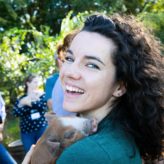

Olivia Fuller, a fourth-generation farmer at Fuller Acres in upstate New York, spent her childhood with dairy cows. As an only child, the farm shaped her sense of identity and community.
“The cows and the farm were my world,” says Fuller. “I had an unofficial litmus test for new friends. If they couldn’t handle being in the milking parlor or around the cows, we likely weren’t going to work out.”
Despite that deep connection, Fuller did not envision farming as her future career. She saw the way of farming she knew best—small-scale dairy farming—as exhausting and financially unstable for her parents.
“Growing up, I only ever saw one way of farming, dairy farming,” she says. “And it was farming that took every ounce of physical energy, grit, and money that one could muster.”
Like many farm kids, Fuller imagined leaving and returning to the farm later in life. She thought she might become a writer or magazine editor, eventually coming back to the farm for a quieter, more recreational connection to the land. But that vision began to change as she and her partner, Tom, spent time away from the farm and learned more about the broader agricultural landscape in America.
Fuller began working at the nonprofit American Farmland Trust, and she saw how difficult it was for young farmers to access land.
“I was amazed to discover that there were so many young people interested in farming,” says Fuller. “There were hundreds, if not thousands, of hardworking young people who desperately wanted what we were fortunate to have, access to land to farm on.”
She realized that her relationship to the family farm was something to be protected, not taken for granted. She and her father applied for New York State’s farmland protection program through a local land trust. This would establish a conservation easement on the farm, permanently protecting the land for agricultural use.
“We were all on board with that idea,” says Fuller. “It was the first big decision we made together on the farm, and it felt like a huge win to be chosen.” The easement closed on Fuller’s 25th birthday in 2017.
But Fuller’s fight to preserve the family farm was far from over. Three years later, Fuller’s mother died of pancreatic cancer. And amid the family’s profound loss, Fuller knew she needed to face a pressing challenge: continuing dairy farming at their scale was no longer economically viable.
“We moved into my grandparents’ old farmhouse and planted our roots even deeper. Saving the farm became my primary mission,” says Fuller. “We had already lost so much, and I couldn’t stand to see Dad lose the farm…But if we stayed the course with dairy, that was a growing possibility.”
The Fullers were losing thousands of dollars milking cows at their scale: “Our equity was crumbling beneath us,” says Fuller. While the conservation easement funds had bought them some time, they needed to make the farm more financially sustainable for the long term.
Fuller stepped into a leadership role, focusing on business planning, marketing, and diversification. She convinced her father to begin breeding some of the dairy herd to beef, slowly building a new business model centered on direct sales. As revenue stabilized, her father’s trust followed.
“I could place cash in my dad’s hands,” she says. “He slowly started to trust me that this could work.”
Eventually, her father made the difficult decision to let go of the family’s milking herd. Fuller Acres transitioned fully to raising beef cattle, pigs, and sheep using rotational grazing, allowing animals to fertilize the land naturally. That winter, the family remodeled the former milking parlor into a self-serve farm store.
“It may not be a dairy barn, but it will never be an empty barn,” Fuller’s father told her.
Today, customers stop by the farm to buy meat and linger to chat, bringing new energy and purpose to the land. But for Fuller, the most meaningful change is seeing her father experience a different relationship to farming.
“He finally doesn’t have to work that hard just to survive,” says Fuller. “He gets to do work he loves. But he also gets to decide when to call it quits and go fishing…And sometimes when I’m really lucky, I get to pick up a fishing pole and join him.”
This article is part of Food Tank’s ongoing Farmer Friday series, produced in partnership with Niman Ranch, a champion for independent U.S. family farmers. The series highlights the stories of farmers working toward a more sustainable, equitable food system. Niman Ranch partners with over 500 small-scale U.S. family farmers and is committed to preserving rural agricultural communities and their way of life. Food Tank was proud to collaborate with Niman Ranch in lifting up family farmer stories, including Fuller’s, at Climate Week NYC: A Night of Storytelling Honoring Our Farmers. Watch her story and others on Food Tank’s YouTube channel.
Articles like the one you just read are made possible through the generosity of Food Tank members. Can we please count on you to be part of our growing movement? Become a member today by clicking here.
Photo courtesy of Olivia Fuller.