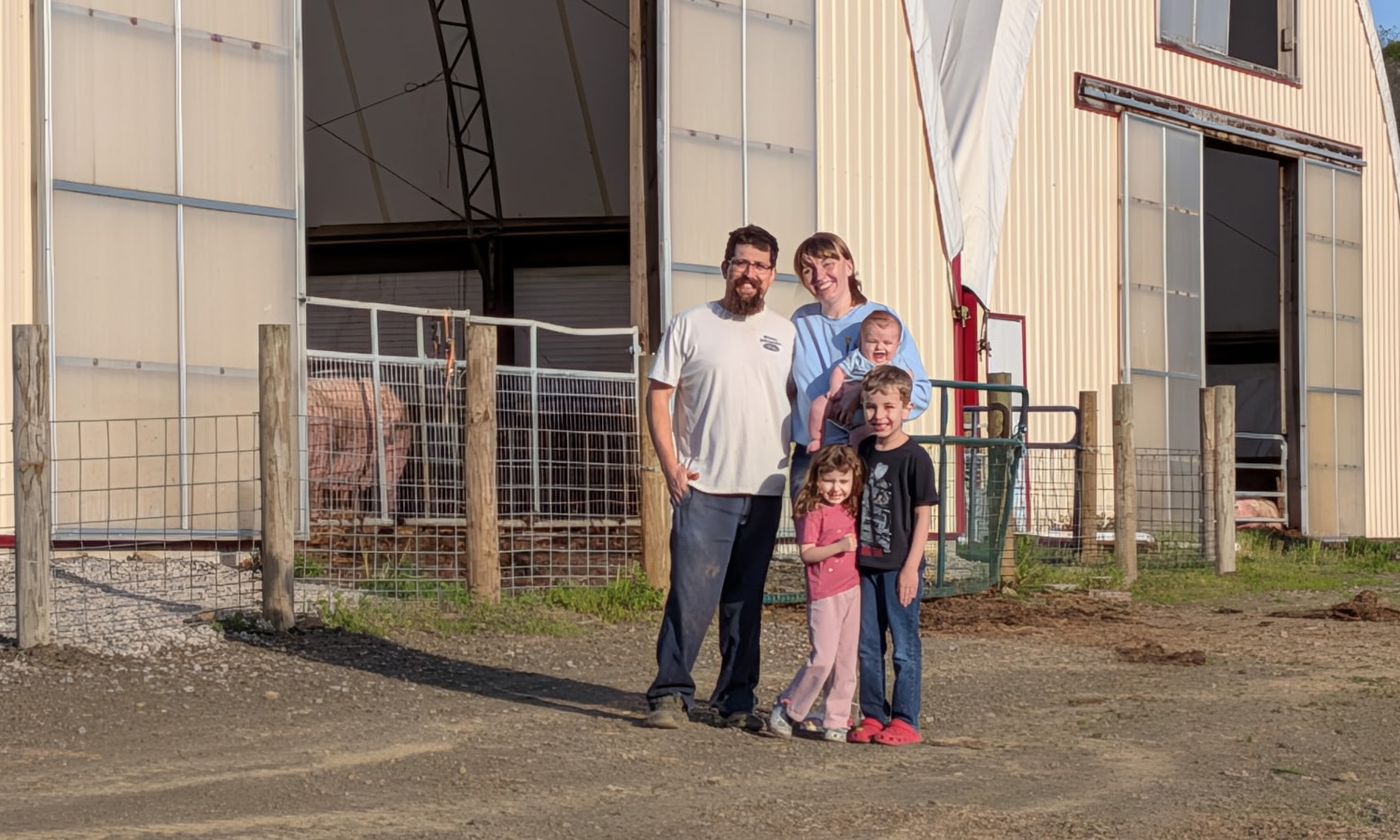
Austin and Shannon Ehrisman raise all-natural hogs on a 22-acre patch of once-overgrown Christmas trees in central Pennsylvania. While the area is home to many hog farms, Austin says raising them outdoors is unusual—and he didn’t think it was possible a few years ago. Even his father thought he was “a little bit crazy” when getting started.
“In Pennsylvania, I was taught to believe you can’t do anything independently or all-natural with hogs,” says Austin. “Around here, everybody’s got some kind of contract [with a large pork company].”
But the cost of setting up a confinement barn—how the vast majority of hogs are raised—has risen significantly since the 1990s. Austin’s father, for example, built a 1,100-pig barn in 1989 for about US$100,000. That same barn today, according to Austin, would be US$400,000 to US$500,000 but rarely are new barns built this small. He says many hog farmers today feel the need “to get bigger, bigger, bigger,” typically borrowing US$1 million or more, to support their families with hog farming which may not be economically sustainable long-term.
When the Ehrismans were in their early 20s, they toured 50 to 100-acre farms—what might be a traditional launchpad for a young farmer. But between the high land cost and the expenses to build barns, they couldn’t make it work financially.
Then an old Christmas tree farm, previously used as a weekend cabin site, went up for sale between Austin’s parents’ and brother’s farms. There were hundreds of Christmas trees that had gone untrimmed for more than a decade, but it could be a farm of their own.
The Ehrismans were able to negotiate a deal within their budget, closing on the farm one year after they married at 22 years old. Then the real work began.
Austin took a job packing eggs at a chicken farm and picked up part-time work at another hog farm, while Shannon worked as a dental hygienist. Full-time farming on their own land was the dream, but there wasn’t a straightforward path to make that a reality. Austin says he and Shannon spent several years “throwing ideas against the wall and seeing what stuck” to make their small, nontraditional farmland profitable.
In 2014, Austin saw a YouTube video by a fellow Pennsylvania farmer that introduced him to a different way of raising hogs. Instead of building a US$1 million confinement hog barn, this farmer raised pigs on pasture or in hoop barns with continual access to fresh air and sunshine. They worked with specialty pork company Niman Ranch, which offered a guaranteed market for pork in exchange for high standards of sustainable and humane farming practices.
Austin realized that this would not only be healthier for pigs but would also work for his 22-acre plot. “Getting started with Niman Ranch is a fraction of what a commercial barn is because you can start at any scale,” he says.
Today, the Ehrismans care for around 200 sows, which are mature female pigs that have raised at least one litter of piglets. Austin also works as a Niman Ranch field agent, helping other independent farmers make small to mid-scale farming work.
For the Ehrismans, their primary goal is making family life possible on the farm. Shannon has reduced her dental hygiene schedule to two days a week, and the family homeschools their seven-year-old son, Lane. Their daughter, Everley, is four years old, and the family recently welcomed a third child, Nathan.
The Ehrismans value the farm being a place where their children can participate and learn. At the confinement hog barns Austin grew up around, farmers need to “shower in, shower out” and wear protective clothing due to the heightened disease pressures in high-density facilities. But on his farm, the hogs are raised in the open air with space to root around and express their natural behaviors. It’s safe for his children to work alongside him, and his older children already help with chores like taking out the trash.
“A farm is the best place in the world to raise kids. There are just so many little things to learn,” says Austin. “The kids are always running in and out…helping with chores, or playing tag in the farrowing barn.”
Articles like the one you just read are made possible through the generosity of Food Tank members. Can we please count on you to be part of our growing movement? Become a member today by clicking here.
Photo courtesy of Niman Ranch