Bruce Friedrich’s new book Meat: How the Next Agricultural Revolution Will Transform Humanity’s Favorite Food―and Our Future argues that plant-based and cultivated meat are humanity’s best hope of mitigating the harms of modern animal agriculture. As a part of making that case, Friedrich offers an insider’s analysis of what’s gone right and wrong in the quest to create plant-based and cultivated meat that compete on price and taste with their conventional counterparts. What follows is a section from chapter seven, which focuses on plant-based meat. Find out more about the book at MeatBook.org.
In my experience, most people—even those excited about alternative meats—believe that making plant-based meat is a culinary endeavor. Mix the right ingredients, get creative with spices and flavors, and voilà: meatless meat.
Their intuition is failing them. That’s not it at all.
GFI scientist Erin Rees Clayton explained to me that plant-based meat is asking biology to do something outside its nature: Plant proteins are globular; animal proteins are fibrous. Plant oils are liquids at room temperature; animal fats are solids. Replicating the structure and functionality of meat with entirely different ingredients isn’t just a matter of culinary craft; it’s a scientific problem.
The two plant-based meat pioneers, Impossible and Beyond, understand this. They weren’t playing with recipes. They hired tissue engineers, molecular biologists, chemists, meat scientists, extrusion engineers, plant breeders, and more. Their goal was not different in degree from the plant-based meat companies that had existed up until that point; their goal was different in kind. They were building a brand-new category from scratch, applying the rigors of science and engineering to food.
Erin expanded on this challenge, explaining her view that the underlying science of plant-based meat is, contrary to my intuition, a lot more complex than the science of cultivated meat: “Virtually no one is trained across the entire plant-based meat production process. Plant breeders can modify and improve crops but often don’t know what happens once those crops leave the field. Protein chemists can extract high-purity proteins but may not understand how different extraction techniques affect flavor, digestibility, or food functionality. Food scientists understand formulation but may not have experience with extrusion. Meat scientists know meat, but they’ve rarely applied their knowledge to plant proteins.”
Pat Brown put it bluntly: “The most important scientific problem in the world,” he said, was “What makes meat taste delicious?” And Impossible Foods was going to find the answer. Pat recruited a team of scientists and treated plant-based meat like an Apollo-level mission.
Allen Henderson joined Impossible in 2014 and worked there for about a decade. He spent his first two years as one of many scientists working on the 2016 burger launch. He told me that most meat and food companies spend less than 1% of their budgets on research, while pharma companies often invest closer to 30%. Pat’s goal, he said, was to out-science pharma. Allen holds a PhD in biochemistry and focused his doctoral and postdoctoral work on protein science. Still, “during my time at Impossible, I learned so much,” he told me. “It felt like we were all living in the protein Renaissance.”
The Impossible team figured out how to mitigate the off flavors from plant proteins. Nature creates many of those off flavors, Allen told me, specifically to protect plants from being too delicious. They don’t want to be eaten. The team built a gas chromatograph-mass spectrometer to identify flavor molecules created when meat cooks. They tested heme (an iron-containing compound that contributes to the meaty taste of meat) from 31 different sources, from clover to cattle to soy, finally settling on a process that produces a synthetic soy-based heme.
Even someone as deeply trained in protein sciences as Allen said there was no way around trial and error: “You really don’t know what you’re going to get until you try it,” he told me. Scaling up or down changed everything. Small tweaks could dramatically shift texture or flavor.
The Quest to be the Next Gardenburger
After Beyond Meat and Impossible Foods started raising substantial sums and Beyond went public at a multi-billion-dollar valuation, a flood of plant-based startups appeared, each pitching themselves as “the next Beyond Meat” or “the next Impossible Foods.” Over and over, their pitch decks featured Impossible and Beyond as comparators. And over and over, though with a few notable exceptions, it was obvious they were fooling themselves.
The biggest red flag? The R&D budgets for almost all these companies were tiny or nonexistent, they didn’t have a chief science officer, and they projected product launches within six to eight months. That’s possible, but only if you’re not actually trying to compete with conventional meat on taste. They weren’t. And they didn’t.
Recall that Impossible Foods—founded by one of the world’s top scientists—spent north of $100 million and more than five years before releasing a product. Similarly, Beyond Meat spent tens of millions of dollars and three years on research before launching its first product. Its breakout hit, the Beyond Burger, took seven years and tens of millions more. That Beyond Burger was the only product besides the Impossible Burger that performed well in FSI’s 2019 taste panels.
Another flag: expensive ingredients and clean labels. Many of these companies’ pitch decks for investors would distinguish themselves from Impossible and Beyond by noting that they used healthier proteins like lupine or lentils. They would also display side-by-side nutrition comparisons indicating that their products would have fewer ingredients, less fat, less sodium, and no unpronounceable ingredients. The focus on lupine and lentils guaranteed that the product would cost a lot more. The focus on low fat and clean labels guaranteed that it would taste nothing like animal meat. In other words: the health food strategy of the past four decades.
All of these veggie meat companies with no research budgets and a commitment to non-soy plant proteins, low fat, and clean labels? They were not the next Impossible; they were the next Gardenburger. That’s fine; that was the entire category until Beyond and Impossible were launched. But just be clear: You’re competing for a share of the $1 billion dollar US veggie meat market; you’re not ever going to compete with the $2 trillion global animal meat and seafood markets.
Pat Brown believes the deeper issue is a failure of imagination: People can’t picture plants precisely mimicking animal meat. Their thinking is stuck in the era of veggie burgers and tofu dogs. He told The New Yorker’s Tad Friend in 2019: “Nobody else has caught on to the fact that this is the most important scientific problem in the world, so their results are just a reheated version of veggie burgers from 10 years ago—maybe with a little lipstick on them.”
Publishers Weekly selected Meat as a top 10 new release in science, writing: “This packed account makes food science feel like an urgent and essential undertaking.” Find out more at MeatBook.org
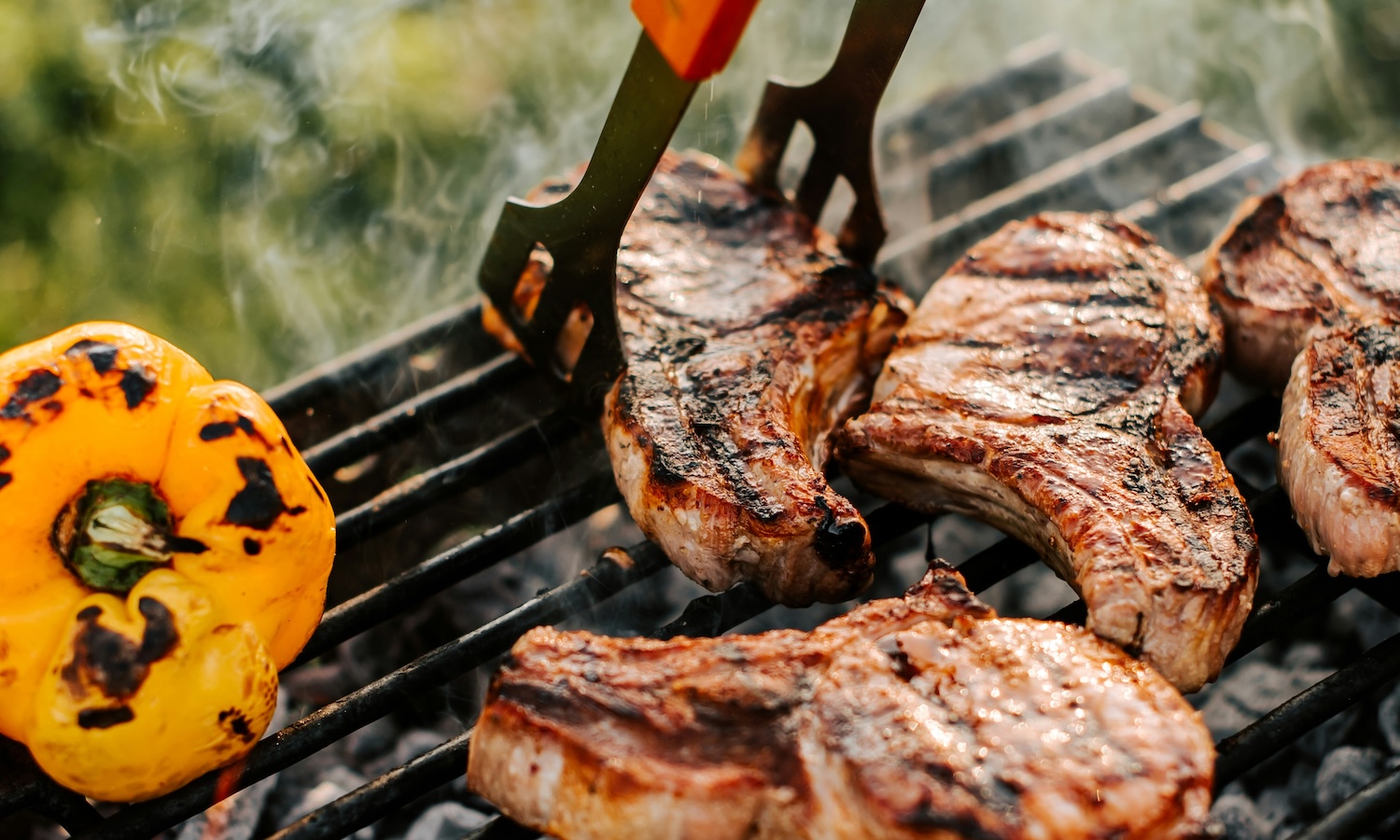
Photo courtesy of Kateryna Hliznitsova, Unsplash