The climate crisis moves quickly. That means our solutions need to move even faster, panelists said during Climate Week NYC.
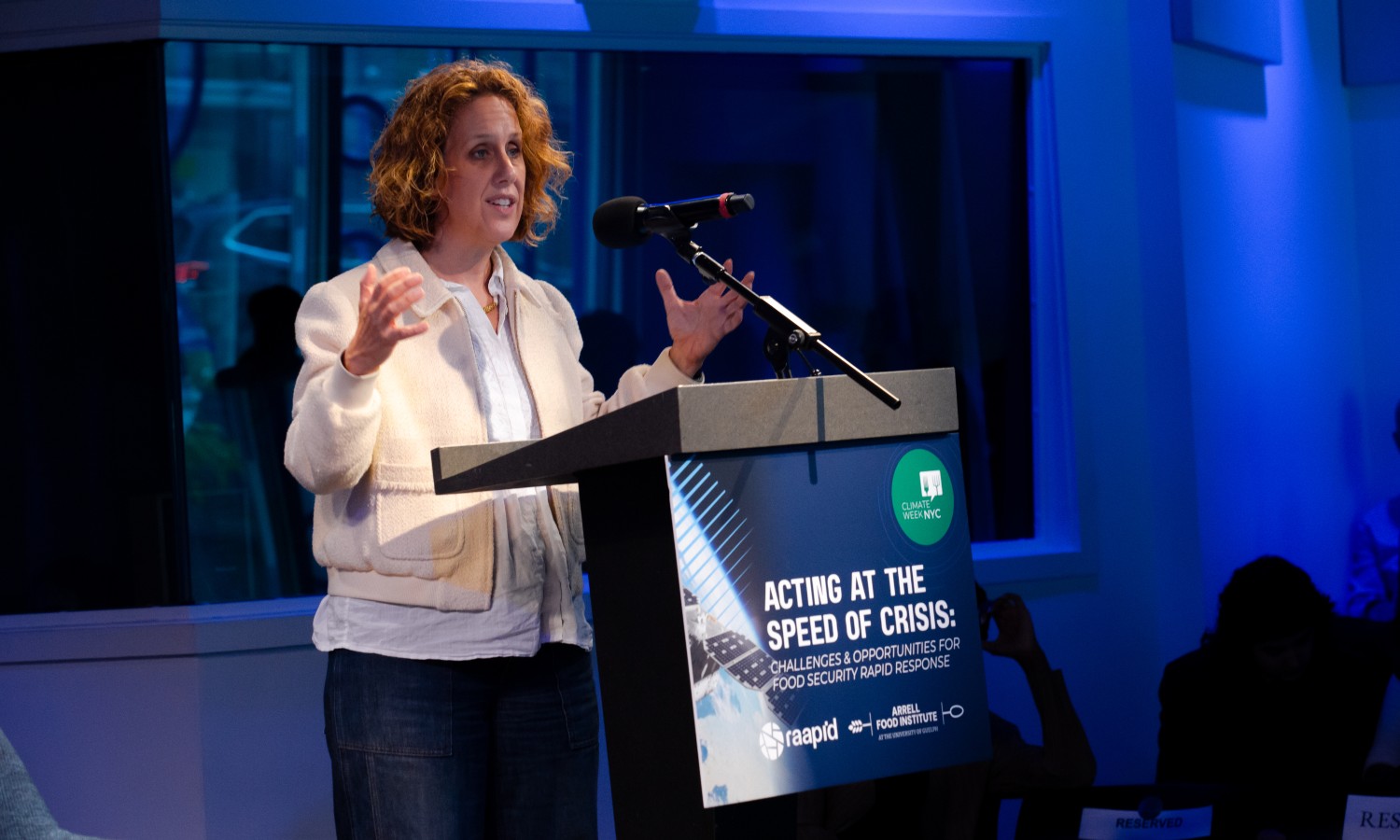
The Summit “Acting at the Speed of Crisis: Challenges & Opportunities for Food Security and Rapid Response,” held in partnership with RAAPID and Arrell Food Institute, brought global leaders together to explore how we can use fast-moving tech to build resilience.
“There are a lot of evolving crises where, if we work together, bringing in both the tech side and the local expertise…we can move faster to get not only early warnings but action when we need it,” says Inbal Becker-Reshef, Managing Director of Microsoft AI for Good Lab, Founder & Co-Director of NASA Harvest, and Founder of RAAPID.
Watch the livestream recording on Food Tank’s YouTube channel.
“It’s easy to get numb to these issues…and the underlying assumptions of the global food trading system are getting eroded,” says Evan Fraser, Executive Director of the Arrell Food Institute at the University of Guelph. “We need the data to anticipate where the problems are going to lead.”
Indeed, says Simon Winter, Vice President for Reimagining Humanitarian Nutrition Security at RF Catalytic Capital, “the prevalence and availability and access to very advanced data is increasing.” But to be able to analyze this data and actually turn information into action, panelists said, we need to work with technological tools like artificial intelligence (AI)—not against them.
“A big part of the challenge is the fact that (we have) vastly more information than human beings can look at, so we need AI,” says Andrew Zolli, Chief Impact Officer at Planet. “Human attention is the scarcest resource we have right now.”
As an example, Planet Remained and the Hewlett Foundation presented a case study of Grapevine, a way to create and replicate city-level policy using AI tools. Broadly speaking, if we don’t adopt AI, we’ll be entering at a disadvantage compared to oil and plastic industries that already do use the tools, says Adam Met, Musician of Multi-Platinum band AJR, Founder and Executive Director of Planet Reimagined, and Adjunct Professor at Columbia University.
“When you gather enough of this data…it makes it easier and easier for a city to say, OK, my city looks like this other city, to be able to implement it,” Met says. “This tool allows them to do it from home,” metaphorically speaking.
Dave Turk, Program Director of Environment at the William and Flora Hewlett Foundation, echoes the value of AI for making the right choice be the easy choice.
“Especially when you get to the local level, it just gets down to pragmatism and problem solving,” Turk says. “The power of AI done right is to make it super efficient.”
Better information-gathering can also help us respond to geopolitical conflicts and wars on a global scale, other panelists explained.
“We are in a very tight situation right now globally,” says Máximo Torero Cullen, Chief Economist of the Food and Agriculture Organization of the United Nations (FAO). “In the case of agriculture, AI is an opportunity.”
For example, because a significant portion of agricultural lands in Ukraine are occupied or impacted by the Russian war, “satellite data is of crucial importance,” H.E. Taras Vysotskyi, Minister of Agrarian Policy and Food of Ukraine, told us via video remarks.
“Globally, we are seeing an increase in the weaponization of food,” says Michael Werz, Senior Fellow at the Council on Foreign Relations. “Food security is one of the few areas where AI doesn’t totally freak me out.”
But technological tools like AI are only valuable if they’re used well and paired with other solutions, says David Beasley, Trustee of The Rockefeller Foundation and the Former Governor of South Carolina and Former Executive Director of the United Nations World Food Programme.
“You’ve got to make sure you have good data; bad data can create a lot of harm,” he says. “You get data, and if you don’t use it strategically, what good is it?”
Better data might help us know where to target our philanthropic dollars and policy resources—but, of course, we can only accomplish these goals if funding and legislation already exist. Just as we need action on strengthening our data collection, we need action on these other social factors, too.
“We have more data, and that data allows us to predict crises better, but unfortunately it doesn’t give us the capacity to act,” says Ambassador Ertharin Cousin, Founder and CEO, Food Systems for the Future. “What does (enable action) are the permissions from government and finance, and that speed has not changed with data.”
We have to be both optimistic and realistic, panelists said: Data can guide us in changing behavior, but data alone does not change behavior. Data can highlight the climate protections that local and renewable energy provide; data can highlight how critical plant-rich diets are toward tackling the climate crisis—but we’re still responsible for building momentum, says Helen Clarkson, CEO of Climate Group.
“It doesn’t just magically happen,” she says.
Explore the entire Food Tank event schedule during Climate Week NYC 2026, and live-stream every Summit on FoodTank.com and Food Tank’s YouTube channel.
Articles like the one you just read are made possible through the generosity of Food Tank members. Can we please count on you to be part of our growing movement? Become a member today by clicking here.
Photo by Ryan Rose for Food Tank.