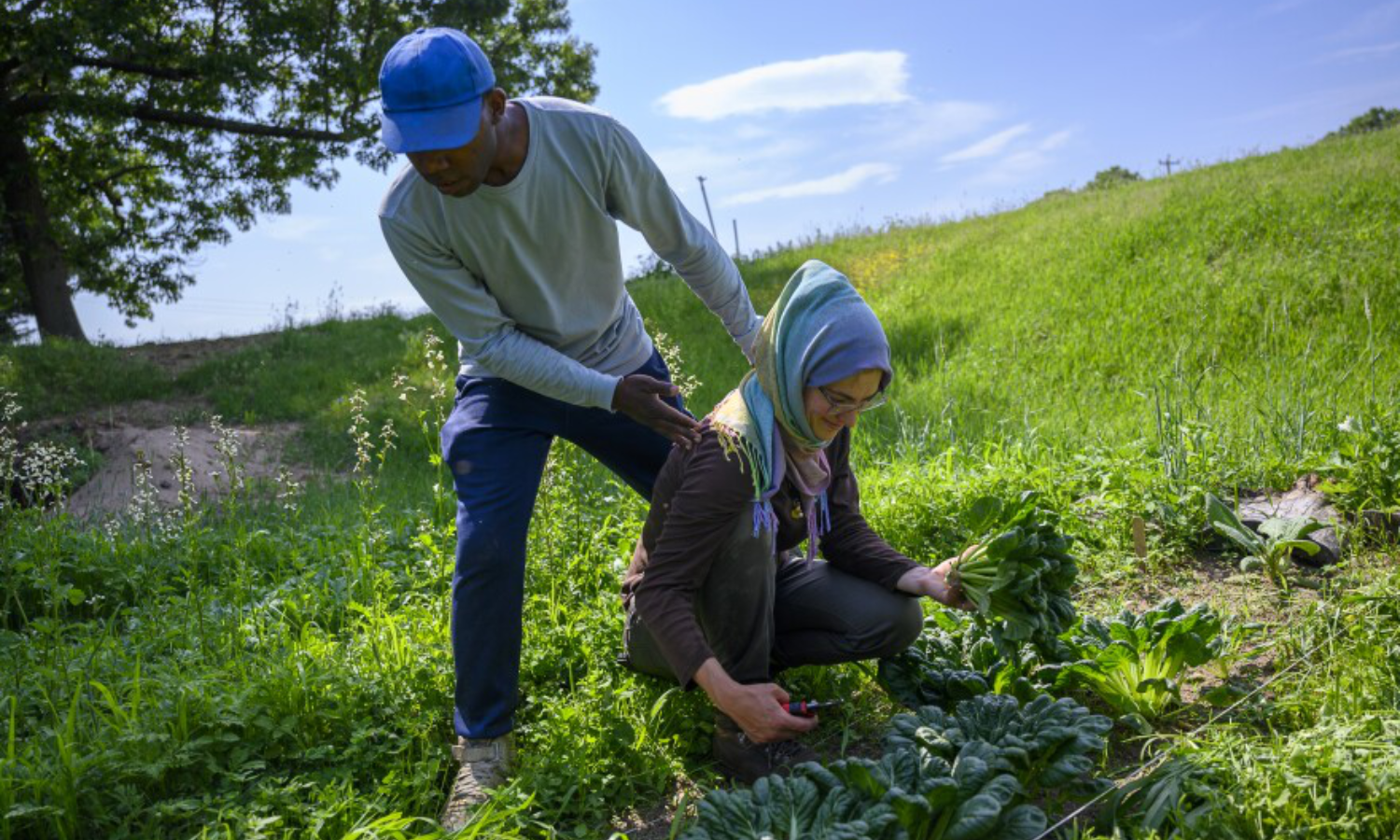
Azeem Zakir Kareem, co-founder of the Samad Gardens Initiative in Bloomfield, Connecticut, did not grow up planning to become a farmer. As a hip-hop artist and breakdancer from Hartford, his path into agriculture began unexpectedly through his wife, Sarah Rose Kareem, who worked on a 26-acre organic regenerative farm. Despite having little exposure to farming, Azeem found a job on the same farm. The experience highlighted how disconnected many urban communities are from the sources of their food.
“I had the craziest culture shock,” says Azeem. “The plant looks like the grocery store, but it’s different…Peppers grow on plants. Tomatoes grow on a vine…There’s pigs over there, and where I’m from, our livestock is pitbulls and rottweilers.”
This planted the seed for what would become the Samad Gardens Initiative, an herb farm and education initiative. The Kareems’ vision was to inspire a new generation of farmers of color and bridge cultural divides in agriculture. They became full-time farmers providing locally grown, nutritious food and hands-on experiences to their community.
But then came the COVID-19 pandemic. Azeem started getting calls from his friends in the cities, who couldn’t find enough food in their neighborhoods. For him, this moment was an epiphany.
“I grew up being hungry…there’s a time in my life I had to steal food to eat,” says Azeem. “My brain was like, I can’t do this by myself. And I’m looking at and dealing with other farmers…We have over 100 black and brown farmers in my state on one network…We have to do something to combat this.”
Azeem realized that individual farms could not meet community needs alone. He leaned into collective action, creating and expanding farmer-led efforts such as the Liberated Land Cooperative, which launched Connecticut’s first-ever statewide Community Supported Agriculture program. The initiative now connects Black and Brown farmers from across Connecticut to provide fresh, locally grown produce to their communities.
Azeem also helped establish the Black-led Sovereign Land Trust and the Venture Farming Institute, an emerging educational and training program aiming to increase the number of underrepresented farmers in Connecticut and Rhode Island.
Through this work, Azeem has become a vocal critic of inequities embedded in the food system.
“The food system works as intended. It’s not broken. It works as intended,” says Azeem, emphasizing that systemic failures disproportionately harm marginalized communities. “What are we going to do when someone sneezes too hard, and the whole thing collapses? That’s been my primary concern.”
Today, Azeem helps farmers not only increase yields but also integrate regenerative practices and prepare for future disruptions. His approach blends agriculture, culture, and empowerment. But his role also extends beyond the field: As a longtime hip-hop artist who has shared stages with popular artists like KRS-One and Public Enemy, Azeem uses his platform to connect with audiences who may not see themselves reflected in traditional food and farming spaces.
“I get to bring this message to different people who look at me like, ‘Yes, it’s real. It’s real,’” says Azeem.
Azeem’s philosophy is grounded in respect for the land. Regeneration, for him, is both ecological and cultural: Repairing soil while restoring relationships between people and the sources of their food.
“How do we treat the Earth like how you treat your mama?” says Azeem. “We call it Mama Earth for a reason.”
This article is part of Food Tank’s ongoing Farmer Friday series, produced in partnership with Niman Ranch, a champion for independent U.S. family farmers. The series highlights the stories of farmers working toward a more sustainable, equitable food system. Niman Ranch partners with over 500 small-scale U.S. family farmers and is committed to preserving rural agricultural communities and their way of life. Food Tank was proud to collaborate with Niman Ranch in lifting up family farmer stories, including Azeem’s, at Climate Week NYC: A Night of Storytelling Honoring Our Farmers. Watch his story and others on Food Tank’s YouTube channel.
Articles like the one you just read are made possible through the generosity of Food Tank members. Can we please count on you to be part of our growing movement? Become a member today by clicking here.
Photo courtesy of Azeem Zakir Kareem