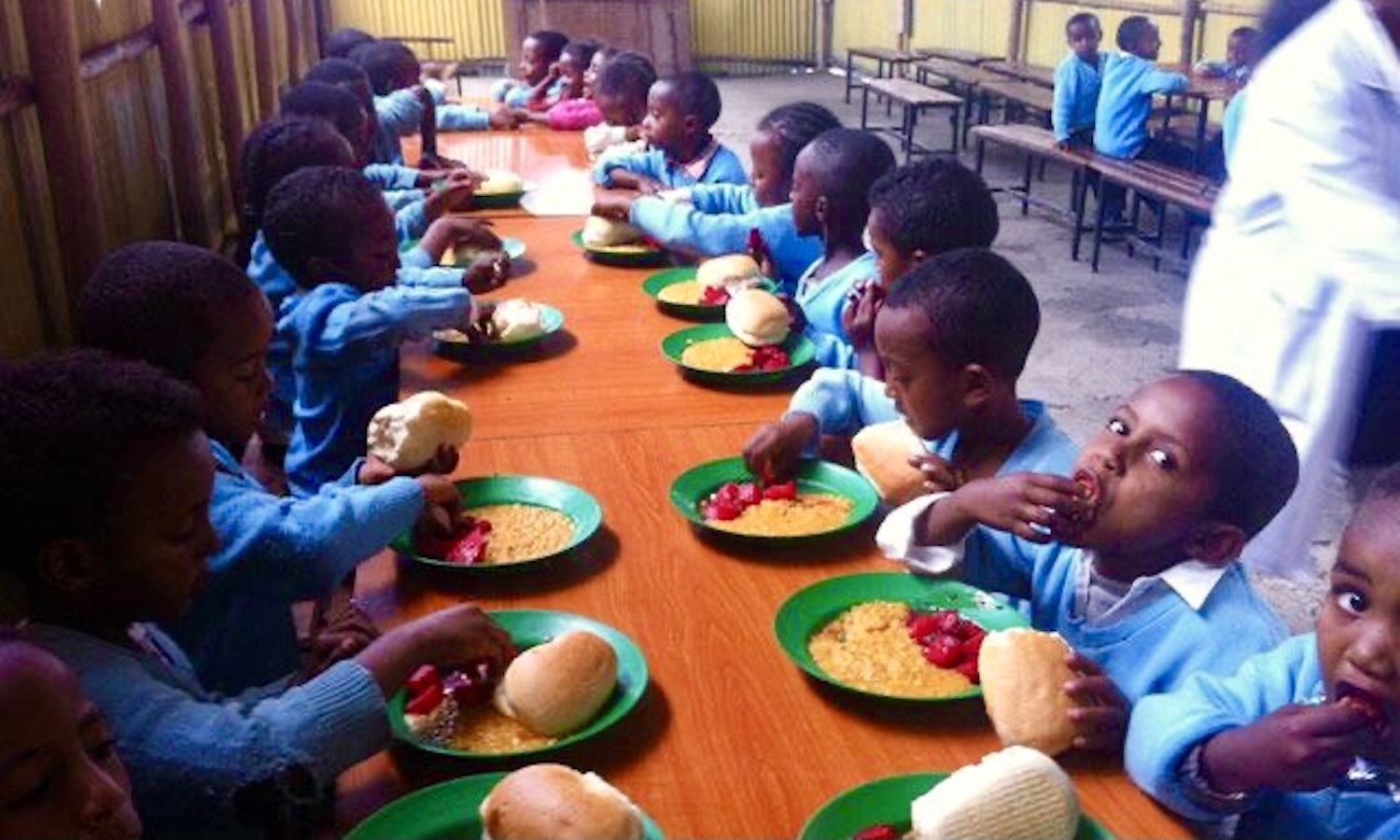
The Rockefeller Foundation is helping regenerative school meal programs scale around the world to nourish children, provide stability for farmers, and transform agriculture systems.
The Foundation’s investment in regenerative school meals aims to connect 100 million children around the world with sustainably grown school meals by 2030. The goal is to nourish young people while supporting local farmers and restoring ecosystems, explains Betty Kibaara, Director of the Food Initiative for The Rockefeller Foundation. “A school meal is a very important tool,” she tells Food Tank, calling these feeding programs “a super initiative.”
An estimated 300 million school-aged children globally go without a nutritious meal each day, according to The Rockefeller Foundation. But when schools nourish students, they can help reduce child hunger and malnutrition by serving a variety of nutritious foods.
“It’s not just about having a plate of food, maize and beans and rice… We want to make sure that what is on the plate is good and nutritious,” Kibaara says. That’s why The Rockefeller Foundation and their partners have worked to bring ingredients including fortified whole grain flour, biofortified beans, millet, and sorghum into school meals in countries such as Rwanda, Burundi, and Kenya.
It’s also about “the impact of a school feeding program beyond a plate,” Kibaara says.
When students are fed, academic performance improves, allowing students to reach their full potential. These programs also encourage children to stay in school—a benefit that’s particularly important for young girls who might otherwise be asked to remain home and care for the household.
Holistic program design that prioritizes sustainable procurement practices benefits neighboring producers too. “Local farmers want to access the market, so we want to make those connections,” Kibaara explains.
She points to Brazil, where the government has mandated that public schools source at least 45 percent of their produce from family farmers and traditional communities. Kenya is exploring a similar approach, helping link farmers to stable markets and better integrate them into school feeding programs. There is room for growth, Kibaara tells Food Tank, “but it’s already working and farmers are earning more money.”
As these programs scale, knowledge sharing between countries, especially those in the Global South, can strengthen them even more. “They say there is no end to learning,” Kibaara says, “and for us, the South-to-South collaboration is an excellent way to learn.”
Watch the full conversation with Betty Kibaara on “Food Talk with Dani Nierenberg” to hear more about how schools are enhancing their feeding programs with gardens and clean cooking technology, the role of philanthropy and the private sector in catalyzing progress, and why government support is needed for the long-term sustainability of this work.
Articles like the one you just read are made possible through the generosity of Food Tank members. Can we please count on you to be part of our growing movement? Become a member today by clicking here.
Photo courtesy of Weremito Peter, Wikimedia Commons