Eating Behind Bars: Ending the Hidden Punishment of Food in Prison received the James Beard Media Award in Food Issues and Advocacy, highlighting the perspectives of incarcerated people and the critical role of food in supporting their health and livelihoods.
The book highlights the work of criminal justice nonprofit Impact Justice. Written by Leslie Soble with Alex Busansky and Aishatu R. Yusuf, it showcases Impact Justice’s programs working to provide incarcerated people with healthy, nutritious food as a gateway to successful reentry into society. Marion Nestle’s What to Eat Now and Greg Mercer’s The Lobster Trap rounded out the nominees for the award category.
“We work in the criminal justice space. Food is in every space, and one of the challenges we have is convincing people in the food space to care about the criminal justice space,” Impact Justice President and Founder Busansky tells Food Tank. “For us to get out of the echo chamber—in terms of funding, government, and the public—is really important. And that’s what we’re trying to do: open the aperture on how people think about criminal justice problems.”
Founded in 2015, Impact Justice conducts research and implements programs to support inmates and others involved in the criminal justice system. Eating Behind Bars was borne from the nonprofit’s 2020 report on the dehumanizing effect of prison food, which featured hundreds of surveys and dozens of interviews with state correctional facility staff and formerly incarcerated people.
The book’s first section, “Hidden Crisis,” illustrates many of the report’s findings: Beyond being bland and unhealthy, food served in prisons in the United States is often moldy, spoiled, and sometimes contains rats or cockroaches. Around 94 percent of people surveyed by Impact Justice weren’t served enough food to feel full during their incarceration, and many who worked in their prison’s kitchens had to cook and serve meat labeled “not for human consumption.”
For Impact Justice, the most important question isn’t why prison food is bad, but rather how it can improve. Criminal justice issues don’t always need criminal justice solutions, according to Busansky.
“This is a problem that can be solved. We know how to feed people—we do it in baseball stadiums, the military, schools, hospitals and nursing homes,” Busansky says. “We know how to feed them good food, food that they want to eat, food they ask for. Since we know how to solve that, how do we go about doing that?”
Over the last few years, Impact Justice has tested several pilot programs to change some of the ways people eat, learn about, and interact with food in carceral environments. Through Chefs in Prison, for example, prisons in Maine underwent improvements in their kitchen operations and menus—led by former Noma chef Dan Giusti—for no additional cost. Additionally, Impact Justice’s Harvest of the Month program provided inmates in each of California’s 31 state prisons with a rotating subset of local, fresh fruits and vegetables.
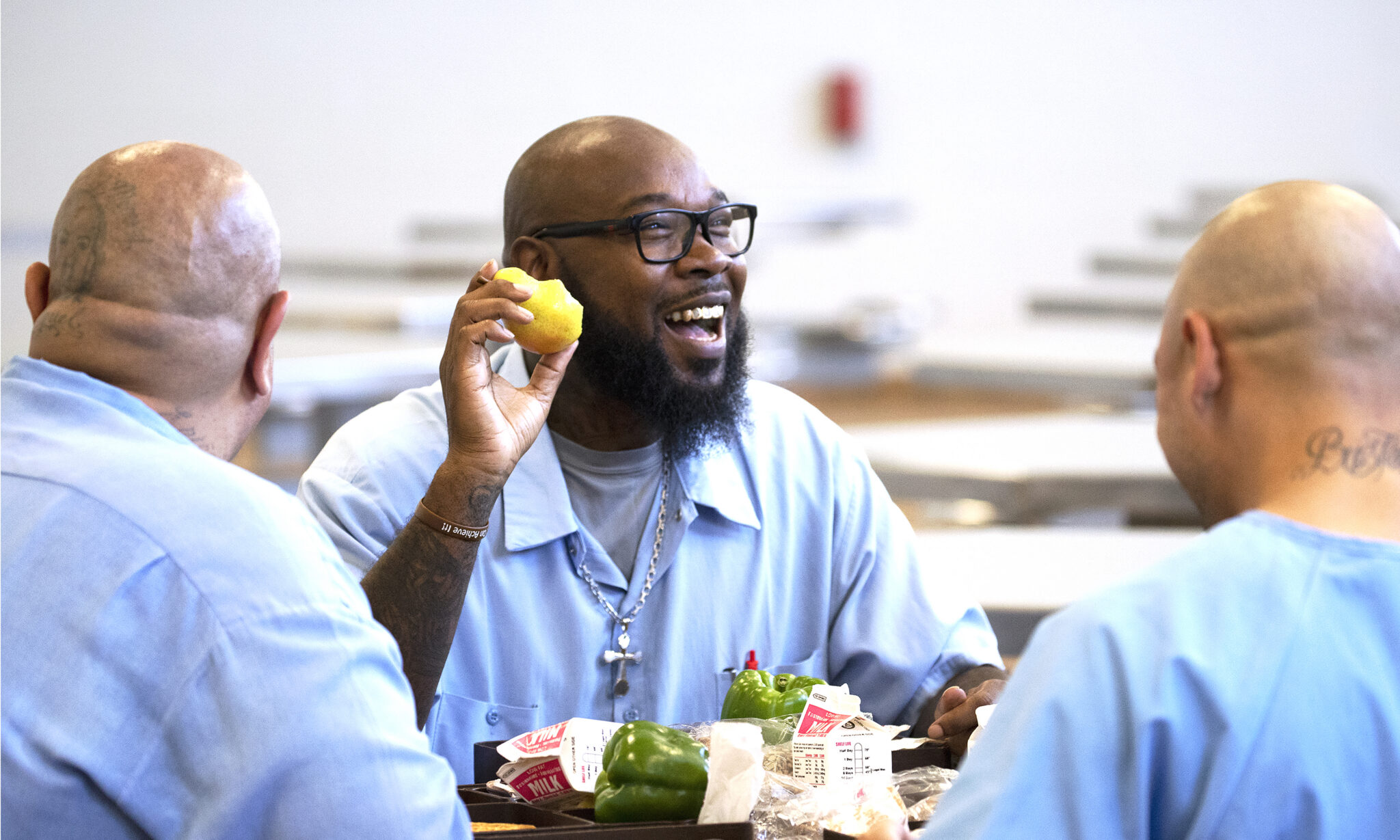
“Last year, we had pears delivered, and we had a gentleman that ate a pear and had the biggest smile on his face,” Yusuf, Impact Justice’s Vice President of Innovation Programs, tells Food Tank. “When asked why he was so happy, he said he hadn’t had a pear in 18 years.”
There’s also an economic case for improving the prison food system, Impact Justice argues. The Department of Corrections and Rehabilitation is California’s largest purchaser of food, according to a 2023 report co-written by Impact Justice. By working with California-based Spork Food Hub to distribute produce from regenerative farms to prisons, the organization hopes to support a circular economy that benefits small businesses.
Impact Justice remains one of few advocates for a more sustainable, equitable prison food system in the United States. As its programs work to turn prison food from punishment to nourishment, the group continues to push the narrative on good food as a human right, including and especially for the incarcerated.
“We’re not talking about gourmet Michelin-star restaurants here,” Yusuf says. “We’re talking about lettuce—food that’s not moldy, that is fit for human consumption, that is nutritious.”
Articles like the one you just read are made possible through the generosity of Food Tank members. Can we please count on you to be part of our growing movement? Become a member today by clicking here.
Photo courtesy of Evett Kilmartin