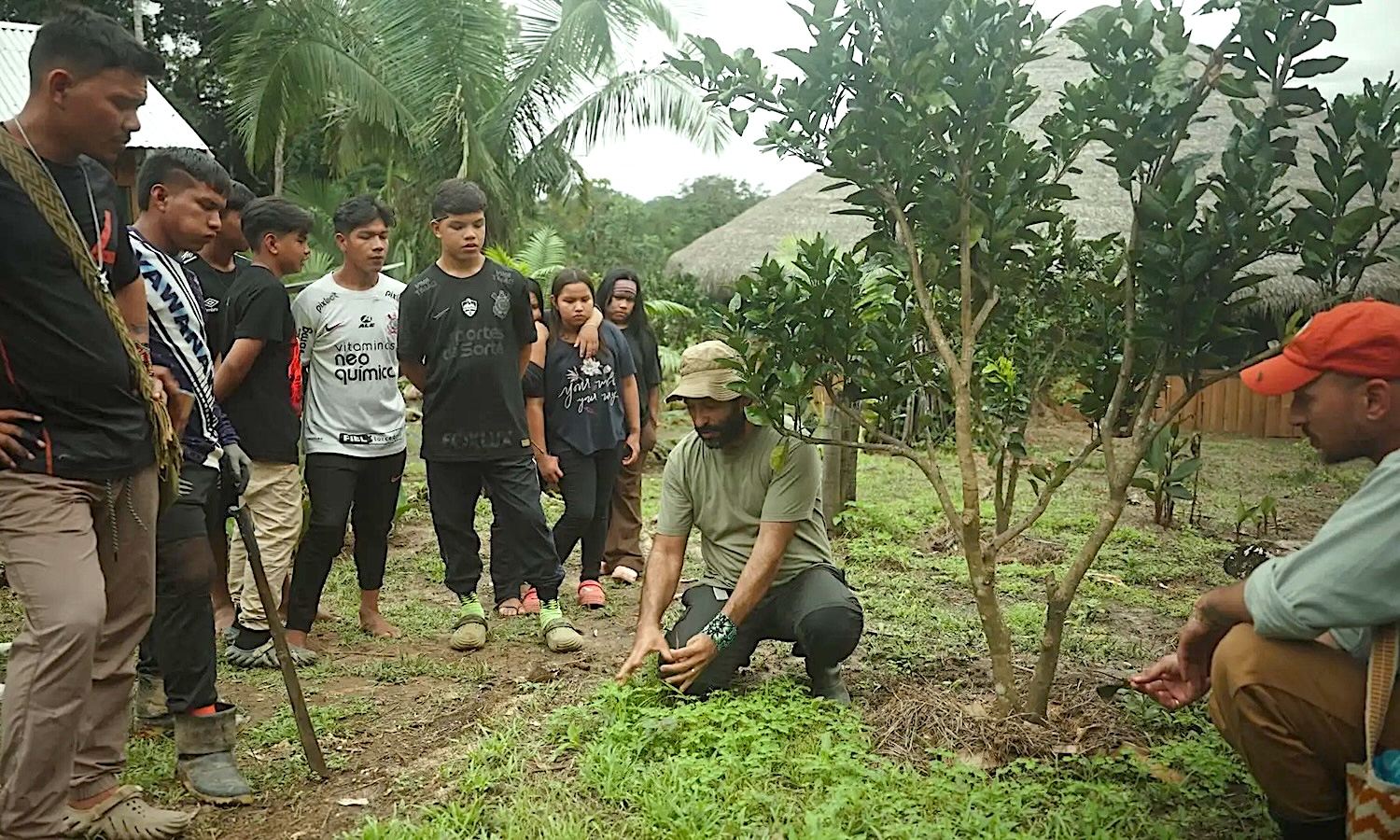
People of the Forest is working with the Yawanawá People of Mutum Village in Acre, Brazil to regenerate degraded forest, empower community members and leaders, and advance Indigenous food sovereignty. A new fundraising campaign aims to help the project deepen its impact.
The project uses agroforestry and Traditional Ecological Knowledge to regenerate degraded Yawanawá land, which spans approximately 500,000 acres of the Amazon rainforest. Their holistic approach aims to strengthen ecological leadership, learning pathways for young people, seed-saving, and community resilience.
“If you know how to use the resources you have in the forest, this is wealth,” Julia Yawanawá, a community leader, educator, medicinal plant wisdom keeper, tells Food Tank.
The project recently entered its third round of fundraising. Donations made through Ma Earth, a collaborative fundraising platform, will be matched through July 21. Provided by Biome Trust, Naia Trust, Imaginal Seeds, and Ma Earth Foundation, the matching funds will help increase the impact and create a greater opportunity for positive change.
According to Ma Earth, there is an estimated US$1 trillion per year funding gap preventing regenerative and community-led initiatives from accessing the resources they need.
Extractive practices, including logging, mining, and ranching, harm the local ecosystems of the Yawanawá territory. The effects of the climate crisis, industrialized farming practices, and the introduction of processed foods further threaten the community members’ wellbeing and livelihoods.
Three years ago, Chief Matsini invited People of the Forest to visit Mutum, the second-largest village of the Yawanawá, and collaborate on a project to support healthier food systems for his people. “A person with a bad heart comes—you give him food and he will feel good,” Chief Matsini tells Food Tank. “Food is the greatest unifier.”
The Indigenous-led initiative is hoping to restore a natural equilibrium between people and the land, which the Yawanawá have stewarded for thousands of years. Its three main goals are to regenerate food systems, reforest native plants, and educate the local communities.
More than 20 Yawanawá have been trained in regenerative practices and over 1,000 native fruit and nut trees have been planted. A 10,000-square-foot agroforestry demonstration plot offers community members a place to engage in land stewardship and ecological leadership. Film, photography, and field documentation also help to amplify Indigenous voices. Through mentorship, youth are learning how to tell their stories in their own voice.
“It is important that this project doesn’t depend on us, it is theirs,” Timo Granzotti, Co-Founder of People of the Forest, tells Food Tank.
The next phase will expand its agroforestry work into other communities by cultivating household kitchen gardens and building nurseries to propagate native species. It will begin community-led design of aquaculture infrastructure to further build local food systems and continue to educate community members. Funding will also provide emerging Indigenous leaders with scholarships to agroforestry schools in Brazil.
“We are not guardians. We are multipliers,” Yawanawá says. “We sow the world, we sow the forest. We are the hands that multiply the food.”
Articles like the one you just read are made possible through the generosity of Food Tank members. Can we please count on you to be part of our growing movement? Become a member today by clicking here.
Photo courtesy of Archie Macpherson