As the dusk of summer nears, I feel embodied with a renewed sense of possibility. Summer has a way of inviting us into our bodies and the landscapes we inhabit. With each hike, I feel stronger. I am acutely aware of my heartbeat on steep inclines, sweat rising and drying almost instantly in the summer sun. I am in awe of the orchestra of wildflower bloom, the air alive with aromas of sage, grass, and juniper. Immersion in forests is itself a practice of health.
Summer can bring another kind of abundance through food. Vegetables and fruits that we eagerly await all year pop with the flavors of the landscape. For our family, the long-awaited fruits of the summer are Flathead cherries. Plump, sweet, tart, and minerally. We eat more whole foods grown close to home, carrying memories of soil, season, interactions with other life, and the hands of our community.
This summer, an unknown about my own health shifted the intensity with which I listen to my body. Health is something we wonder about and manage every day, yet sometimes an unknown can bring it into extraordinary focus, reminding us how deeply we value each other and participating in life. It brought me back to three deceptively simple and connected questions: What is health? How do we know what is healthy? And how do we cultivate health?
Across cultures, people have cultivated traditions of health grounded in different epistemologies, worldviews, observations, and forms of evidence. The field of medical anthropology explores this question, examining how health and healing are understood and experienced.
Ayurveda understands health, or svasthya, through balance among body, mind, food, behavior, season, and environment. Food and medicinal plants are integral to maintaining health and treating illness, with transformation central to their effects. The Ayurvedic concept of agni, often translated as digestive fire, considers what we eat and our capacity to digest and transform it, while prana speaks to the vital life force that sustains us. Agni reminds us that the same food may result in different biological exposure in different people depending on their constitution.
Traditional Chinese Medicine and Tibetan medical systems offer their own understandings of balance, including relationships among food, medicinal plants, individual constitution, season, and environment.
Years earlier, during fieldwork with Piaroa and Yekuana Amerindian communities in Venezuela’s Amazonas, I had asked this same question: What is health? Their responses expanded health beyond the individual. Health was collective, expressed through the vitality of families and communities, including the number of people in a community, and through relationships with the landscapes that sustained them. In Amazonian shamanic traditions, health extends further into cosmology. Plants, animals, people, spirits, and landscapes inhabit relational worlds in which healing extends beyond the individual body.
Since 1948, the World Health Organization has defined health as “a state of complete physical, mental and social well-being and not merely the absence of disease or infirmity.” The NIH Whole Person Health framework similarly considers the whole person, emphasizing interconnected biological, behavioral, social, and environmental domains.
These ways of knowing reveal health as biological, personal, collective, and relational, shaped by what we eat, what our bodies make of it, the communities to which we belong, the living world we inhabit, and what we have access to.
And how do we know what is healthy? People have come to know what heals through observation and experimentation, taste and experience, and knowledge and evidence accumulated across generations. Humans learned to navigate landscapes of bitter, astringent, and potentially toxic plants through their senses and trial and error, discovering that some compounds that deter consumption can also have medicinal properties. This knowledge has shaped what people eat, avoid, and use for healing along a food-to-medicine continuum. This chemical diversity continues to shape medicine, with roughly half of small-molecule drugs tracing their structural origins to natural products.
Biomedical and molecular sciences expand how we know what is healthy through measurement. As a first-year doctoral student, I heard the late food chemist Edwin Frankel lecture on inflammation as a root of disease and the role of foods in exacerbating or mitigating inflammation. Over two decades of evidence later, inflammation has emerged as a biological thread across many chronic diseases, while diets rich in fruits, vegetables, whole grains, legumes, nuts, and seeds are associated with lower inflammation and chronic disease risk. Beyond essential nutrients, these foods contain prebiotic fibers, peptides, and diverse bioactive metabolites that interact with inflammatory pathways, metabolism, and the gut microbiome.
Human health also relies on planetary health. Understanding what is healthy means understanding what health looks like in the living landscapes that produce our food, from soil and biodiversity to the fungi, microbes, and other organisms that sustain food systems.
Omics technologies enable precise characterization of the molecular diversity of foods and their interactions across complex diets, revealing distinct biomolecular signatures. These same tools can measure biological responses to what we eat through biomarkers. AI can also connect food molecular patterns to human proteins and pathways. We can further build new evidence by backtracking to existing epidemiological and clinical studies to link molecular signatures of foods and diets with health outcomes. Predictions can then be tested experimentally and clinically, taking us from food molecular composition to biological exposure and health outcomes.
Ultimately, this growing evidence base is powerful for establishing intake ranges for food molecules whose structures and functions we may not yet know and, where scientifically supported, thresholds for harmful and health-supporting biomolecules to inform dietary guidelines and public health recommendations.
Collectively, this is the frontier of understanding food as biological exposure, one where we should dedicate resources, investments, and capacity strengthening toward healthier food systems. This is perhaps what excites me most about this emerging chapter of my career: the possibility of finally understanding the continuum of soil to food to health at unprecedented resolution and translating that knowledge to improve lives for all.
As our capacity for discovery grows, so must our capacity for stewardship. Access and Benefit Sharing, Indigenous Data Sovereignty, and attribution must advance alongside discovery.
I also thought deeply about what it means to cultivate health this summer while developing an opening keynote for the WSU Bread Lab’s Grain Gathering, Cultivating Health and Nourishing Community with Food Intelligence. Amid the dreamy, diversified farms of the Skagit Valley, the idea came alive. At six in the morning on the second day of the gathering, farmers, breeders, millers, bakers, researchers, and makers gathered around a wood-fired oven making whole-grain bagels. At the center was one of humanity’s most ancient and essential crops: wheat.
Wheat offers a lens into how we cultivate health. A breeder selects for flavor, resilience, nutrition, and performance. A farmer cultivates that potential through soil, biodiversity, climate, and management. A miller determines what flows through the system, and a baker transforms flour with water, microbes, and heat. Our emerging work through The Periodic Table of Food Initiative (PTFI) is revealing how the molecular and health attributes of wheat vary among varieties and shift with production and processing practices, including fermentation. This transformation continues when we eat. Our gut microbes transform components of wheat into metabolites that interact with our immune system, metabolism, and cells.
During the bagel breakfast at the Grain Gathering, I was asked many incredible questions, but one made me stop and reflect: What makes you hopeful? In the face of uncertainty, tragedies, suffering, inequity, and threats to human and planetary health, hope itself can feel audacious. I find hope in the expansive possibility of knowing the continuum from soil to food to health at a resolution we have never known before, toward better lives for all. I find hope in gratitude for this beautiful living world. In love, higher purpose, the greater good, and faith in the goodness of humanity.
I have come to understand cultivation as creating the conditions for flourishing. Health is cultivated in much the same way. We cultivate health through the seeds we select, the landscapes we steward, the foods we grow, the knowledge we generate, the ways we move and rest, and the relationships we nourish. We cultivate it by expanding access, integrating healthy food into healthcare, and creating food systems where the healthy choice becomes the easy choice. Health is deeply personal and collective. Our health cannot be separated from the health of our communities and the living planet we share.
As the dusk of summer nears, I am grateful for the remarkable gift of participating in life. To cultivate health is to cultivate the conditions for life to flourish.
This essay is part of Food Tank’s Flourish Series: Food and Health from Molecules to Systems, authored by Selena Ahmed, exploring how food connects us to the living world while asking what it means to flourish. For more in the series, click here.
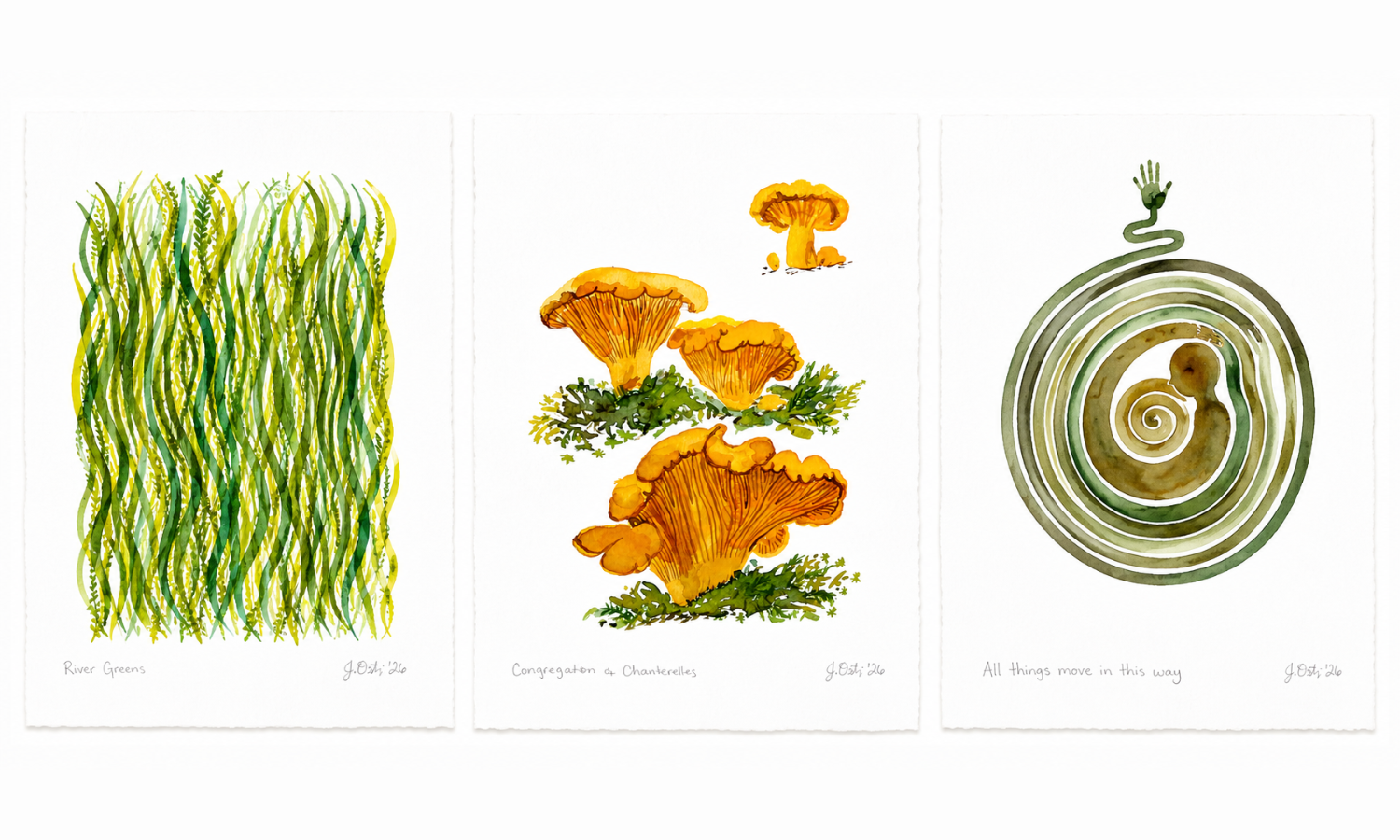
Artwork courtesy of Jeannie Ortiz commissioned for The Periodic Table of Food Initiative (PTFI) and Food Tank’s Flourish Series. All rights reserved.