You know those memories of childhood that catch you decades later when you are doing something entirely different, thinking about something entirely different? For me, one that frequently finds me is waking to the call of the vegetable pushcart walla while visiting my grandmother’s flat in Karachi.
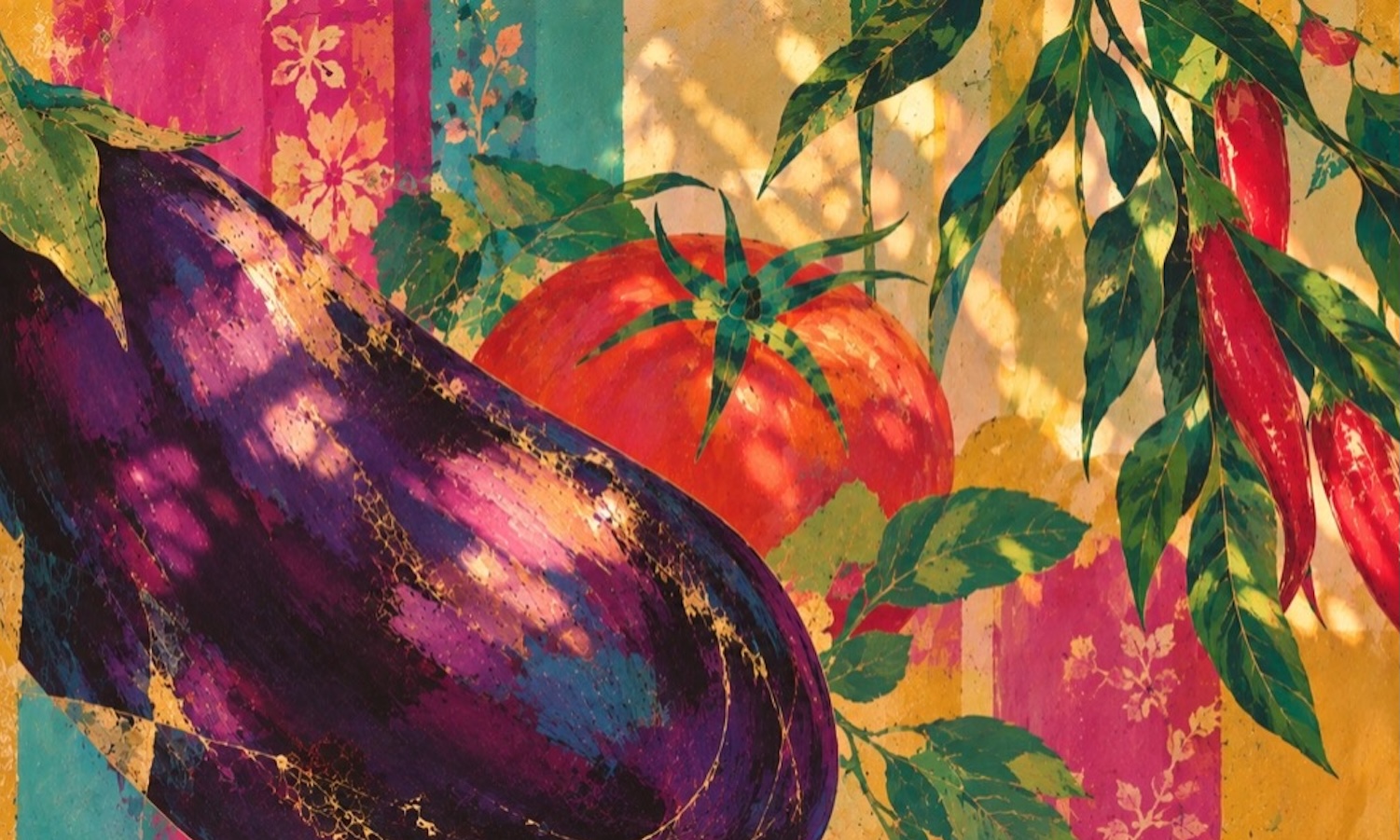
Aloo-ooo, Py-azzzz, Tamatarrrr, Baiṅgan. Sabzi! Sabzi! Sabzi!
(Potato, onion, tomato, eggplant. Vegetables! Vegetables! Vegetables!)
Warm summer morning air filling the room, the fan turning overhead. Waking next to my sister, the two of us insisting on sleeping in my grandmother’s beautiful salwars that were probably not ready to be turned into pajamas. The sounds of traffic humming from the dusty streets below.
I could not see him, but he was ever present as his voice crisscrossed the neighborhood announcing fresh vegetables. And he always called out the price. His call made clear that price was part of the enticement. A good deal was passing by.
That unseen vegetable pushcart was a pocket of possibility.
Each day, Dadu, my grandmother, would sit with Sherbano, who worked in her home, and methodically go over what would be cooked. Dish by dish, they discussed who would be eating, what ingredients were still needed, the cost of the meal in relation to the week’s budget, and what else had been cooked that week. Sometimes Sherbano would double-check what remained from Juma Bazar (the Friday farmers market) or from the supermarket, where shelf-stable foreign goods like canned cheese were available.
Sherbano and my grandmother discussed what to look for when purchasing each vegetable: its appearance, size, texture, freshness, and aroma. Let’s not buy it if it’s not fragrant. The potatoes should be this size. Always the freshest. We’ll only know how many curry leaves and chilli peppers we need once the cooking starts. The aroma should pop.
Planning the day’s meals was a priority. Dadu and Sherbano held these discussions with seriousness, and occasionally argument, as each brought her own knowledge and skill to food procurement and meal preparation. These conversations brought out the most serious side of my grandmother. At most other times, there was always an excuse for a little fun, let’s paint the town red!
Sherbano returned with the day’s purchases to my grandmother’s tiny kitchen. There were a few pots. She sat on a low woven stool and cut vegetables on a cutting board on the ground. With her knowledge, skill, and labor, she transformed whole food ingredients into meals that brought joy. Meals that were festive and nourishing. Meals I long for.
That kitchen in my grandmother’s home was another pocket of possibility.
The vegetable pushcart walla was one of many who started around 3:00 a.m., purchasing vegetables from the Sabzi Mandi before dispersing across neighborhoods. Without a storefront, they helped keep fresh vegetables within reach. Across generations and geographies, mobile vendors have carried fruits, vegetables, grains, and more toward people in baskets, bundles, and pushcarts.
Most of us do not experience the food system in its entirety; we experience it through food environments. Food environments are the living confluences where climate, biodiversity, agriculture, markets, policy, culture, economics, nutrition, and health come together in our daily lives. Collectively, these relationships shape food availability, affordability, convenience, promotion, quality, and sustainability.
The Sabzi Mandi, Juma Bazar, supermarket, and vegetable pushcarts were all part of the built food environment my grandmother accessed. Built food environments extend from traditional markets and mobile vendors to supermarkets, restaurants, schools, hospitals, workplaces, and digital marketplaces. People also obtain food directly from wild and cultivated food environments, from forests, rivers, and coastlines to farms, fields, and home gardens.
I have delighted in co-creating frameworks, tools, metrics, and surveys to understand diverse food environments. What we define and characterize determines what we see and measure, and what we measure determines what we can manage. If we only measure food available in markets, we miss extraordinary pockets of food diversity in wild and cultivated food environments and the knowledge and relationships that make them accessible.
Food can be available but unaffordable. It can be affordable but poor quality, culturally irrelevant, or undesirable. Diverse foods can persist in a landscape while the knowledge to recognize, harvest, prepare, and value them disappears.
Food environments are dynamic. We are living through a profound global food-environment transition, with growing availability of ultra-processed and ready-to-eat foods and more food consumed away from home. These shifts bring convenience while distancing us from food knowledge and agency once practiced in our kitchens.
A pocket of possibility can shrink. It can also be expanded.
My grandmother’s kitchen reminds me that access to fresh and affordable ingredients was only part of what made those nourishing meals possible. Dadu had support. She and Sherbano brought knowledge, skill, labor, and time to making those meals, discerning quality, working within a budget, minimizing waste, and adjusting ingredients until the aroma popped. Nourishment requires an enabling environment inside the home, too. Today, many of our kitchens have vacancies in time, labor, knowledge, skills, and support.
But we are not going back to our grandmothers’ kitchens, nor the labor arrangements that helped make them possible. The opportunity is to carry the best of that knowledge and intention forward while finding new ways to fill some of the vacancies.
Policies can support mobile vendors in bringing fresh, affordable food closer to home. They can also help community gardens flourish, while hunting, fishing, and foraging can enhance food access. Food education can help navigate increasingly complex food and information landscapes. Where Dadu and Sherbano brought knowledge and collaboration to the meal, better food-quality data and emerging AI tools for meals can offer new forms of support. One possibility we are exploring is Swap It Smart, powered by data from The Periodic Table of Food Initiative (PTFI).
The meal itself becomes another pocket of possibility.
Meals can heal. Evidence is growing that interventions centered on meals can improve diet and health. Providing convenient access to minimally processed meals improved dietary quality and mental health symptoms in a randomized controlled trial. Medically Tailored Meals can improve health outcomes and reduce hospitalizations and healthcare costs. Culinary medicine and cooking interventions can build knowledge and skills to prepare healthier foods. Universal school meals can improve children’s health at population scale, while school meals from regenerative agriculture extend those benefits to planetary health.
Across interventions and scales, the same fundamental possibility emerges: creating the enabling conditions and support for good food to become a nourishing meal.
As leaders and advocates gather in New York around the U.N. General Assembly and Climate Week, conversations about climate and health unfold at planetary scale. We do not have to invent every solution anew. Food environments are powerful levers because so much of the food system converges there. Some of these solutions have been moving through our streets for generations. Others are growing in home gardens. Some emerge from tiny kitchens, where what is available meets knowledge, skill, care, and imagination.
Bring good food within reach.
As we pursue planetary-scale solutions, some of the largest pockets of possibility may already be within reach.
From the dusty streets rises the familiar call.
Sabzi! Sabzi! Sabzi! (Vegetables! Vegetables! Vegetables!)
This essay is part of Food Tank’s Flourish Series: Food and Health from Molecules to Systems, authored by Selena Ahmed, exploring how food connects us to the living world while asking what it means to flourish. For more in the series, click here.