In a new documentary, The Vegan Poultry Farmer, filmmaker Kadir van Lohuizen follows Ruud Zanders as he grapples with a moral dilemma: raising animals for food while following a vegan diet. Zanders travels the globe, meeting with food systems experts, to determine if an animal-free food system is possible.
“Personally, I would say: stop exploiting farm animals,” Zanders says in the documentary.
Zanders opened the first Kipster farm in the Netherlands in 2017 after his large-scale poultry operation went bankrupt. He realized that large-scale farms are efficient and produce cheap eggs, but “something else is paying the price… biodiversity, the climate, the animal itself,” he tells Food Tank.
His farming model, he says, is based on sustainability, animal welfare, and transparency. Zanders ultimately envisions an animal-free food system, but until that becomes a reality, he aims to provide the highest-welfare eggs possible. “It’s very complicated to produce eggs or other animal-based products in a really animal-friendly way,” Zanders says.
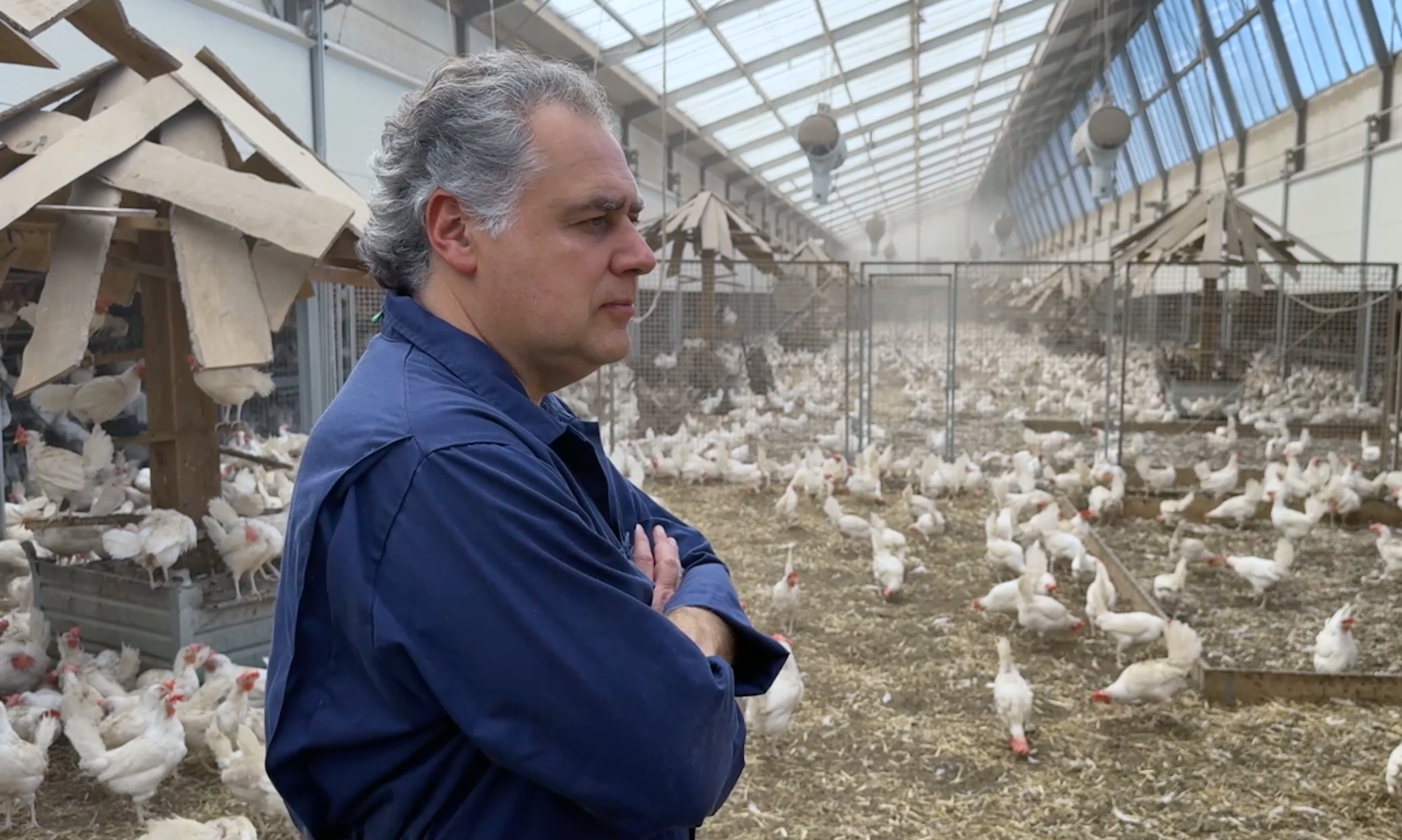
His farms house 24,000 chickens per barn, compared to industrial operations which can hold up to 350,000 per barn, according to the Animal and Plant Health Inspection Service (APHIS). The chickens receive indoor and outdoor space, fresh air and sunlight, and an enrichment playground to exercise their natural instincts.
Kipster is working to produce carbon neutral eggs by giving their chickens feed made from waste streams, including stale pastries or other food no longer fit for human consumption. This feed model eliminates competition for food (corn, grains, soy) between people and farm animals. Zanders bases this model on the idea that growing crops directly for human consumption can decrease agricultural land usage and allow for more land to be restored to natural ecosystems.
He was inspired to do this by Imke de Boer, a Wageningen University professor of livestock and sustainable food systems, as well as environmental activist and writer George Monbiot, who Zanders visits in the film. Monbiot tells him that livestock farming is the single most destructive human activity to the environment.
The farm also uses solar panels and transforms chicken litter into fertilizer. They report that a Kipster egg’s carbon footprint is about 23 percent lower than that of a conventional egg.
The documentary examines behind the scenes of Kipster farms and other operations to reveal the industry’s reality. It shows chickens being shoved into crates to be transported to slaughter, limp carcasses dangling on a conveyor belt, and workers wearing blood-spattered aprons. Even under Kipster’s higher-welfare standards, the end result is still the same.
Zanders meets with various stakeholders to help him answer the film’s driving question: Is an animal-free food system possible?
Melanie Jaecques, co-owner of a farm animal sanctuary in Belgium, saves chickens predominantly from the egg industry. She talks to Zanders about the complexity of chickens’ behavior and personalities, and that even on his higher-welfare farm, they are not given the proper environment to thrive. To her, housing 24,000 chickens in one barn is “terribly wrong,” and that Kipster is “not a good system, but the least bad.”
To answer his logistical questions about fertilizing crops without animal manure and whether people can maintain proper health on a vegan diet, he visits a human waste fertilizer producer in Ghana and a plant-based hematologist, respectively. Together, these experts affirm his belief in an animal-free agriculture system—which only intensifies his internal struggle as a poultry farmer.
Although Zanders concludes that it is possible to have an animal-free food system, he knows that his vision is not shared by all. As long as there is a demand for animal products, Zanders hopes that Kipster can help bridge the gap between his ideal vision and the current industrial system. That’s why he believes that he can positively impact farm animals as a poultry farmer. “We have to do our utmost best to give them a life worth living.”
Articles like the one you just read are made possible through the generosity of Food Tank members. Can we please count on you to be part of our growing movement? Become a member today by clicking here.